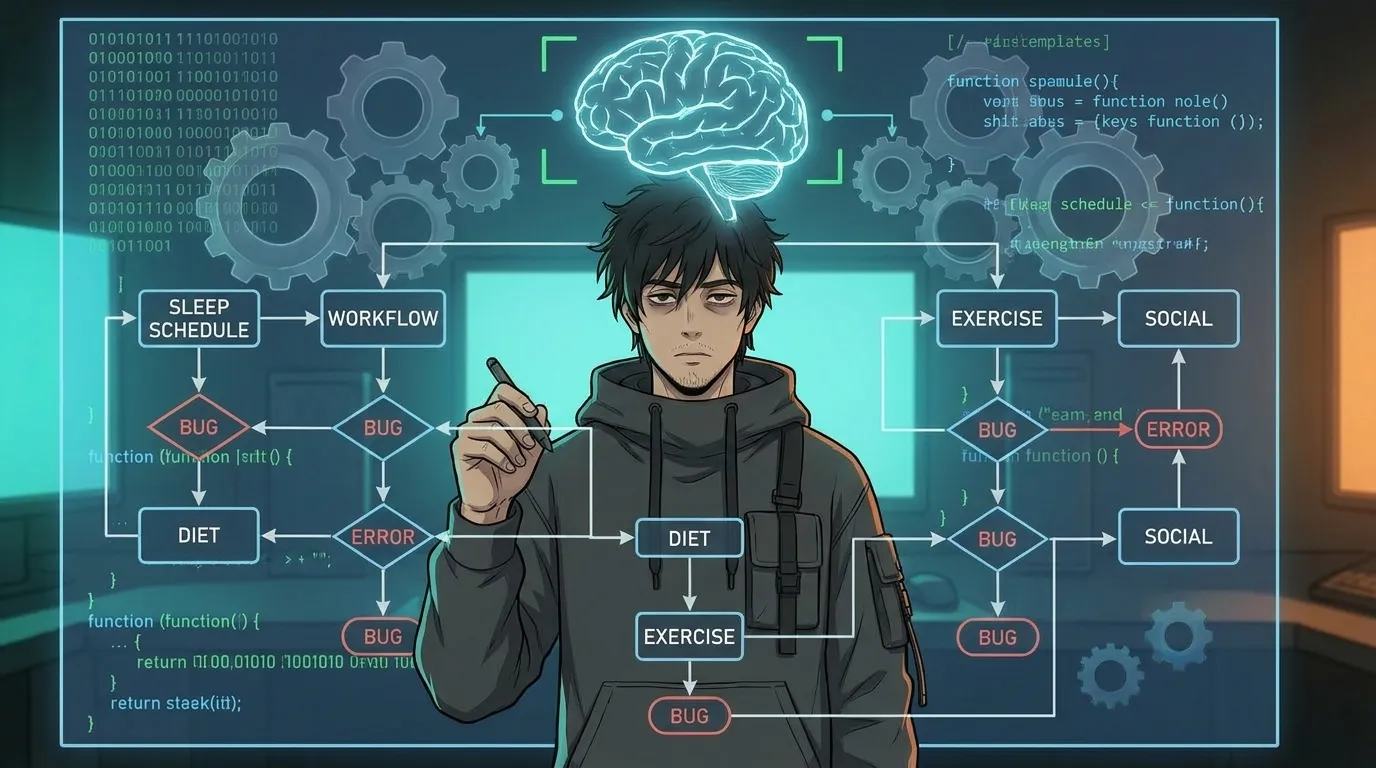
Have you ever felt stuck trying to improve yourself, collecting tip after tip, template after template, yet seeing little real change? The problem isn’t a lack of information—it’s the absence of a thinking framework that tells you how to use that information. In personal development, most advice is scattered, contextual, and reactive. What if you could treat your growth like a software system: perceiving inputs, modeling reality, designing protocols, building infrastructure, measuring performance, and continuously optimizing?
That’s exactly what the PDES (Personal Development Engineered System) does. It borrows the rigor of computer science—state machines, loops, memory management, debugging—to turn vague aspirations into a debuggable, optimizable process. At the heart of PDES lies a powerful set of thinking frameworks that act as the system’s instruction set. This post will walk you through what thinking frameworks are, why ordinary mental models fall short, how PDES engineers them into a 32‑level ladder, and how you can start applying them today to engineer your own growth.

What Are Thinking Frameworks?
A thinking framework is a structured way of processing information, making decisions, and solving problems. Think of it as an algorithm for your mind: given certain inputs (goals, obstacles, data), it produces an output (action plan, belief, habit). Unlike a single mental model—which is a static analogy like “the egg‑in‑a‑basket” for risk diversification—a framework is dynamic. It includes steps, feedback loops, and criteria for when to iterate.
Examples of well‑known frameworks in other domains:
- Scientific Method: Observe → Hypothesize → Experiment → Analyze → Conclude.
- OODA Loop (Boyd): Observe → Orient → Decide → Act.
- DMAIC (Six Sigma): Define → Measure → Analyze → Improve → Control.
In personal development, we need frameworks that operate on the same principles but target internal states: beliefs, habits, emotions, and skill acquisition. PDES supplies exactly that.
Why Mental Models Alone Are Not Enough
Mental models are invaluable for understanding the world—maps of reality. However, a map does not tell you how to navigate terrain, especially when the terrain changes. Relying solely on mental models leads to three common pitfalls:
- Static Application: You apply the same model to every situation, ignoring context shifts.
- No Feedback Mechanism: Models don’t tell you when they’re failing; you keep using a broken map.
- Missing Execution Layer: Knowing a model is different from having a routine that turns insight into action.
PDES solves this by embedding mental models inside a larger thinking framework that includes perception, modeling, design, building, measurement, and optimization—the six‑phase engine that drives continuous improvement.
The PDES Approach: Thinking as a System
PDES treats your personal development pipeline like a software stack:
- Input Layer (
/perceive) – Raw data: journal entries, metrics, feedback. - Processing Layer (
/model,/design) – Convert inputs into a state machine, define goals, design protocols. - Build Layer (
/build) – Generate SOPs, trackers, and habit infrastructure. - Measurement Layer (
/measure) – Apply Life Quant metrics (win rate, drawdown, Sharpe, etc.) to assess performance. - Optimization Layer (
/optimize) – Debug, refactor, and automate the habit loop.
Each phase relies on specific thinking frameworks to convert cognition into action. For instance, during /perceive you might use a “Cognitive Bias Scan” framework; during /model you employ a “State‑Machine Mapping” framework; during /optimize you run a “Debug‑Cycle” framework akin to a software debugger.
The 32‑Level Ladder of Thinking Frameworks
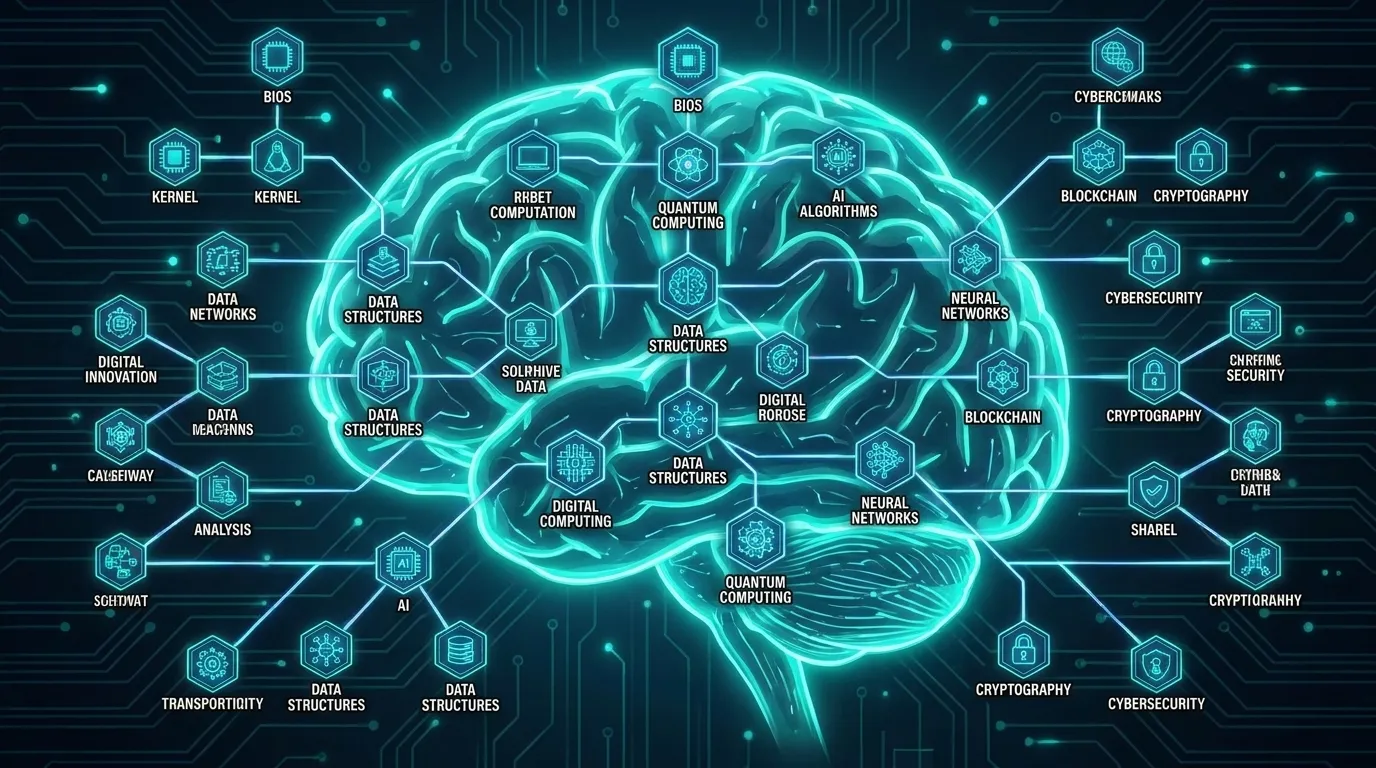
Just as computer science has layers—from BIOS to quantum computing—PDES maps 32 progressive levels of thinking frameworks to human development. Each level (G{z|0≤z≤30}) introduces a new abstraction, expanding your cognitive toolkit.
Here’s a glimpse of the ladder (the full list appears in the /level skill):
- Null: No framework; reactive, stimulus‑response.
- BIOS: Basic perception‑action loops (e.g., “if‑then” habit triggers).
- Syntax: Recognizing patterns in language and thought (e.g., “subject‑verb‑object” for clarifying goals).
- Variable: Storing and updating mental states (e.g., tracking energy levels as a variable).
- Loops: Repeating processes with improvement (e.g., daily review loops).
- Memory: Short‑ and long‑term recall strategies (spaced repetition, chunking).
- Logic: Boolean reasoning for decision trees (AND/OR/NOT in goal setting).
- I/O: Managing inputs (information diet) and outputs (expression, creation).
The ladder continues through concepts like Object‑Oriented thinking (G8), Inheritance (G9), Threading (G10 – parallel habit stacks), Virtualization (G11 – mental simulation), Cloud (G12 – distributed cognition via tools), and culminates in G30 – Quantum: probabilistic thinking, superposition of multiple perspectives, and entanglement of goals.
By progressing through these levels, you stop collecting isolated tips and start installing a coherent operating system for your mind.
How to Apply Thinking Frameworks in Daily Life
Application begins with a simple habit: at the start of each day, run a micro‑version of the PDES pipeline.
- Perceive (2 min): Open your journal, note sleep quality, mood score (1‑10), and any urgent signals. Use the “Cognitive Bias Scan” framework to ask: What am I assuming without evidence?
- Model (3 min): Translate notes into a short state machine: State = Energy Level; Triggers = Meetings, Meals; Transitions = Breaks, Exercise. Sketch it on paper or a digital tool.
- Design (5 min): Choose one protocol for the day (e.g., “Pomodoro + Movement”). Define entry/exit conditions and success criteria.
- Build (2 min): Set up a tracker—a simple spreadsheet row or a habit‑app entry—logging start/end times, interruptions, and perceived focus.
- Measure (throughout day): At each interval, record data. At day’s end compute basic Life Quant metrics: Win Rate = (% of Pomodoros completed without major distraction), Drawdown = biggest dip in energy score.
- Optimize (5 min): Review the tracker. Ask: Where did the loop break? Apply the “Debug‑Cycle” framework: reproduce the fault, isolate the variable (e.g., a specific meeting), hypothesize a fix (buffer time), implement tomorrow.
Repeating this daily installs the thinking frameworks into muscle memory. Over weeks, you’ll notice:Faster identification of cognitive distortions.More accurate self‑models that predict energy and focus.Habit stacks that run with minimal willpower.Objective data that guides iteration rather than guesswork.
Measuring Impact with Life Quant Metrics
Thinking frameworks are only valuable if they move the needle on tangible outcomes. PDES borrows ten quantitative metrics from trading and adapts them to life:
- Win Rate – % of successful executions (e.g., completed deep‑work blocks).
- Drawdown – Maximum loss from a peak in a key metric (energy, productivity).
- Risk/Reward – Ratio of effort invested to outcome gained.
- Expectancy – Average gain per cycle, factoring win/loss sizes.
- Sharpe Ratio – Return (progress) per unit of volatility (stress).
- Position Sizing – How much time/effort to allocate to a goal given its risk.
- Profit Factor – Gross gains divided by gross losses.
- Max Favorable Excursion – Best‑case upside achieved in a cycle.
- Recovery Factor – Net profit divided by maximum drawdown.
- Opportunity Cost – Value of the next best alternative foregone.
By tracking these metrics weekly, you get a dashboard that tells you whether your thinking frameworks are truly improving your system’s performance—or merely adding complexity.
Optimizing and Debugging Your Thought Processes
Even the best frameworks develop bugs: cognitive biases creep in, outdated assumptions persist, or feedback loops become too slow. PDES treats these as system defects and applies a debugging workflow:
- Reproduce: Trigger the situation that produced the undesired outcome and observe the internal state.
- Isolate: Use a “binary search” of mental variables—turn off half your current frameworks, see if the bug persists.
- Hypothesize: Formulate a precise conjecture about which framework or rule is faulty.
- Experiment: Implement a small change (e.g., swap a “To‑Do List” framework for a “Kanban‑Flow” framework) and measure the result.
- Validate: Run the experiment for enough cycles to achieve statistical significance (use the Life Quant metrics).
- Deploy: If validated, roll out the fix across all relevant contexts.
This cycle mirrors a software team’s bug‑bash, ensuring your mind evolves as a reliable, high‑performance system.
Putting It All Together: Your Personal Development Engine
Imagine your mind as a computer:
- Hardware: Your biology—sleep, nutrition, exercise.
- Firmware (BIOS): Core loops and reflexes (G0‑G4).
- Operating System: The PDES six‑phase engine.
- Applications: Domain‑specific skills (career, health, relationships) built on top of the OS.
- Updates & Patches: Continuous optimization via the debug cycle.
When you upgrade your thinking frameworks, you’re not just adding another app—you’re improving the OS itself, making every application run smoother, faster, and with fewer crashes.
Start Engineering Your Growth Today
The journey from scattered tips to a fully engineered personal development system begins with a single decision: adopt a thinking framework, run it through the PDES pipeline, measure the result, and iterate. The 32‑level ladder gives you a clear progression path; the Life Quant metrics give you objective feedback; the debug cycle guarantees you keep improving.
If you’re ready to stop collecting tips and start building a system that thinks like you do, explore the full PDES methodology.
This link delivers the complete PDES starter pack: the six‑phase engine, the level‑by‑level framework guide, and the Life Quant tracking template—everything you need to boot your personal development OS.
Remember: In personal development, the highest leverage point is not more information—it’s better thinking. Upgrade your thinking frameworks, and the rest of the system will follow.