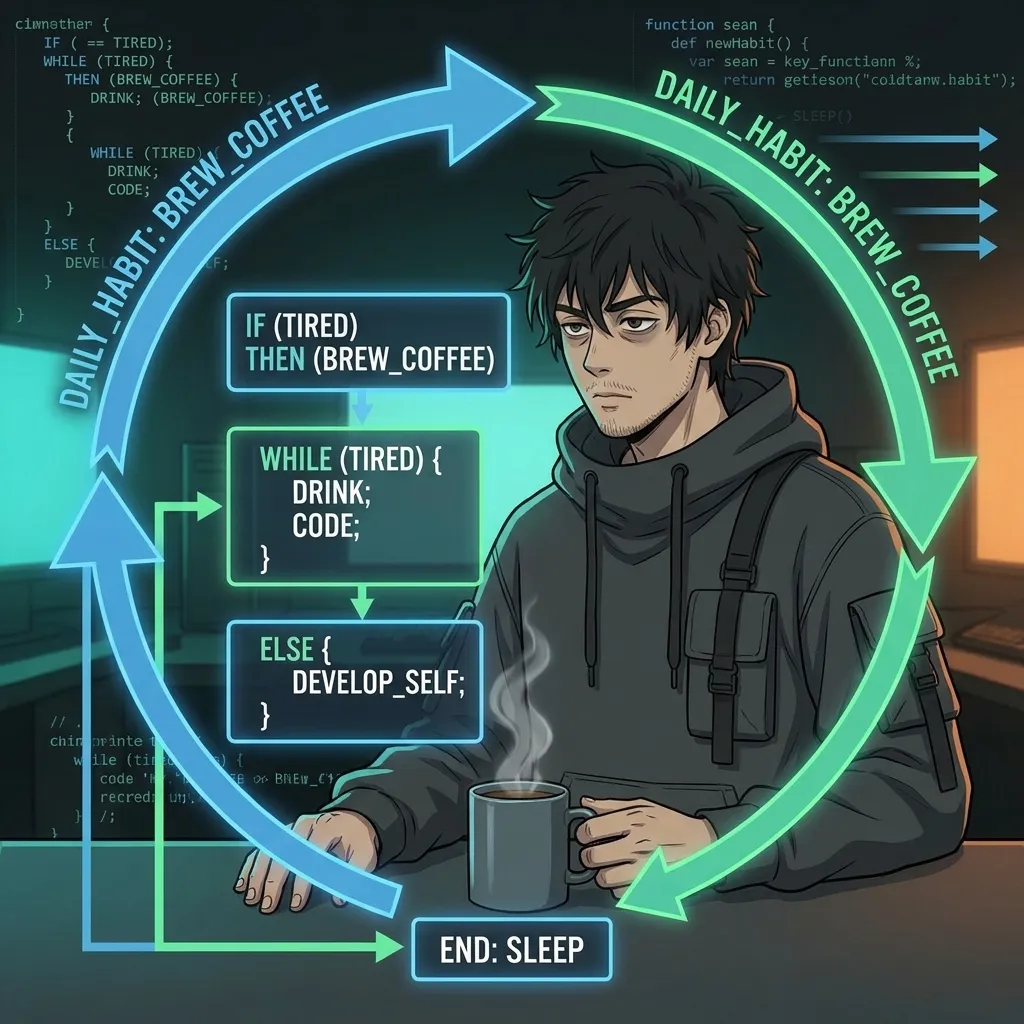
Do you ever feel like you’re spinning your wheels—setting goals, trying new habits, but never seeing the progress you deserve? What if you could treat your life like a software system: perceive bugs, model the code, design patches, build fixes, measure performance, and continuously optimize?
That’s exactly what a personal development methodology does. By borrowing proven concepts from computer science and systems engineering, you gain a repeatable, debuggable process for upgrading every area of your life—career, health, relationships, and mindset.

What Is a Personal Development Methodology?
A personal development methodology is a structured framework that turns vague self‑improvement wishes into concrete, measurable actions. It gives you:
- A clear starting point (perceive your current state)
- A way to model reality as a system (states, inputs, outputs)
- Actionable designs (protocols, SOPs, habit loops)
- Built‑in measurement (KPIs, Life Quant metrics)
- A feedback loop for continuous optimization
“dp/da: Every action should increase your probability of success or reduce your cost.”
The PDES Framework: Input → Process → Output
PDES (Personal Development System) mirrors a computer’s pipeline:
- Input/ – Drop raw data, journals, goals, and metrics here for scanning.
- Skills/ – The six‑phase engine (Perceive, Model, Design, Build, Measure, Optimize) processes those inputs.
- Libraries/ – Read‑only registries of frameworks, taxonomies, and reference models.
- Templates/ – Ready‑made SOPs, trackers, and checklists.
- Output/ – All generated reports, logs, and progress artifacts.
By following this pipeline, you turn subjective experience into objective data that can be tracked, analyzed, and improved.
The 32 Problems, 32 Fixes: Mapping Life to Computer Science
Every human challenge maps to a foundational CS concept. For each concept there is a fix protocol—a “debug” step you can apply immediately.
- Null / BIOS – Lack of direction → Run a boot‑sequence: define your core values and vision.
- Syntax – Vague goals → Write SMART statements (proper syntax).
- Variable – Inconsistent habits → Declare and track key variables (sleep, water, deep work).
- Loops – Reactive cycles → Replace with intentional feedback loops (review → adjust).
- Memory – Forgetting lessons → Build a personal knowledge base (zettelkasten).
- Logic – Poor decision making → Apply truth tables and decision trees.
- I/O – Information overload → Filter inputs, set output goals (content creation, delegations).
- Object – Identity confusion → Model yourself as an object with attributes and methods.
- Inherit – Limiting beliefs → Override inherited methods with new, empowering ones.
- Thread – Multitasking misery → Use single‑threaded focus blocks (pomodoro).
- Virtual – Environment mismatch → Create virtual contexts (digital declutter, workspace presets).
- Cloud – Scaling impact → Leverage cloud‑style systems (automation, outsourcing).
- Server – Burnout → Deploy load balancing: schedule recovery, set rate limits.
- Access – Opportunity blindness → Implement API‑style networking (clear requests, rate‑limited outreach).
- Algorithms – Ineffective routines → Optimize with Big‑O thinking (eliminate O(n²) habits).
- DataBase – Poor knowledge storage → Normalize your information (tags, schemas).
- Low‑level – Ignoring fundamentals → Master basics: nutrition, movement, breath.
- Locking – Procrastination → Use mutex‑style commitment devices (public pledges).
- SuperCom – Complex projects → Break into parallel tasks with map‑reduce mindset.
- Compiler – Skill translation → Turn theory into executable code (practice → feedback).
- Kernel – Core identity → Audit and patch your core beliefs.
- Root – Permission issues → Gain admin rights over your time and energy.
- Quantum – Uncertainty → Embrace probabilistic thinking, run experiments.
- Error – Mistake intolerance → Log errors, apply blameless post‑mortems.
- Source – Stagnation → Fork your life, create feature branches for new experiments.
- Merge – Integration challenges → Use pull‑request style reviews before merging changes.
- Encrypt – Privacy leaks → Apply strong boundaries and data minimization.
- Admin – Governance gap → Schedule weekly “system admin” reviews.
- Hidden – Untapped potential → Run deep scans (journaling, therapy) to surface hidden assets.
- Anonymous – Lack of accountability → Deploy transparent tracking (public logs, accountability partners).
- No Code – Over‑reliance on complexity → Adopt low‑effort, high‑impact habits first.
How to Apply the Methodology: Perceive, Model, Design, Build, Measure, Optimize
Here’s a quick‑start checklist you can run today:
- Perceive – Do a 10‑minute brain dump: What’s working? What’s draining you? Capture metrics (sleep hours, deep‑work minutes, mood score).
- Model – Turn your dump into a simple state machine: Identify states (e.g., “Focused”, “Distracted”, “Recovering”) and triggers that move you between them.
- Design – For each problematic state, design a protocol (SOP). Example: When in “Distracted”, invoke a 2‑minute breath reset → clear task list → start pomodoro.
- Build – Write the SOP in your tracker (Notion, Todoist, paper). Create a habit‑stack cue.
- Measure – Apply Life Quant metrics: Win Rate (% of protocol completions), Drawdown (longest streak of missed protocols), Expectancy (average gain per protocol run).
- Optimize – Review weekly: Which protocols have the highest ROI? Drop low‑yield steps, automate repeats, and iterate on the state machine.
Repeat this cycle every week. Over time, you’ll accumulate a personal “codebase” that is version‑controlled, documented, and continuously improving—just like any professional software project.
Get Your Free 32 Problems / 32 Fixes Cheat Sheet
Ready to start debugging your life? Download the free cheat sheet that maps every common life problem to a Computer Science concept and gives you the exact fix protocol to apply today.
After you download the cheat sheet, you’ll also receive a brief email series walking you through the first three phases of PDES so you can begin modeling your reality right away.