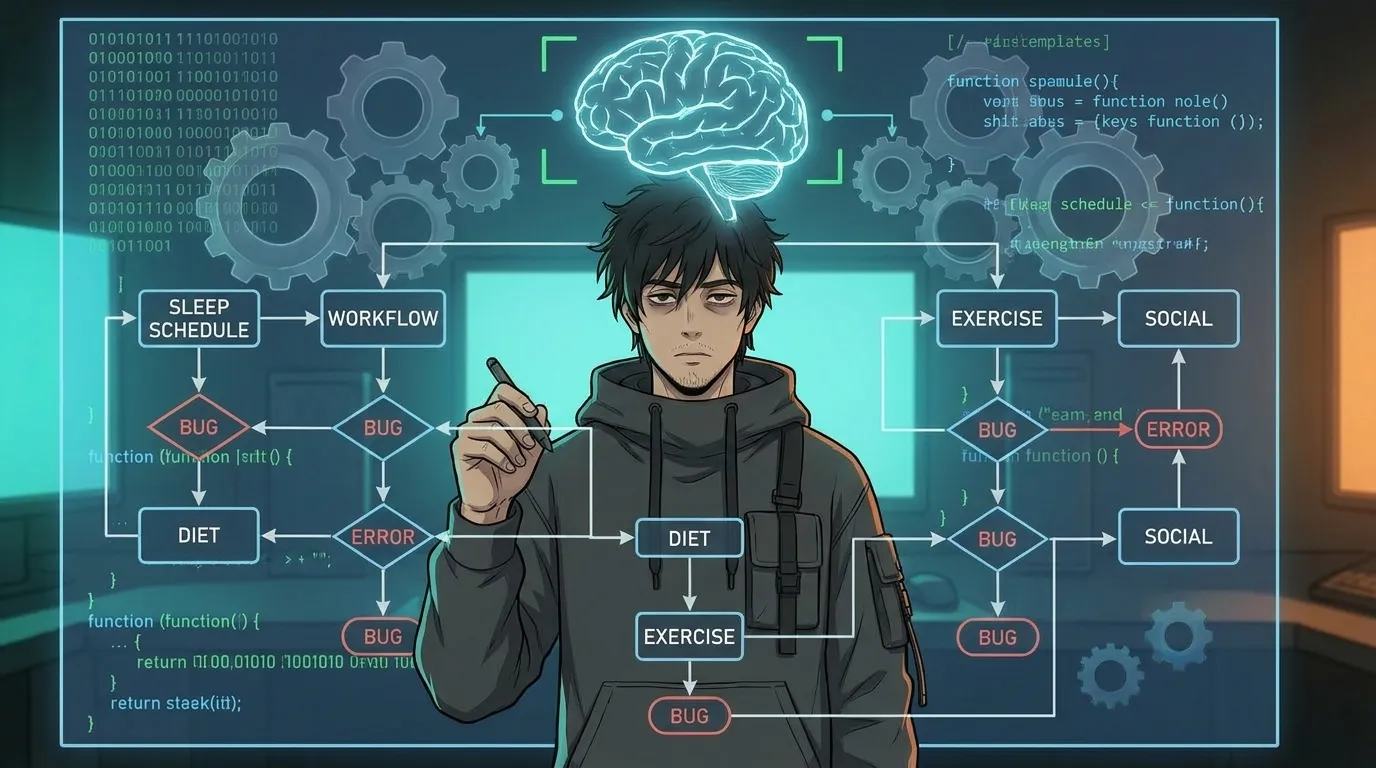
If you’ve ever felt that self-help advice is too vague, too anecdotal, or simply “not for engineers,” you’re not alone.
Analytical thinkers crave structure, measurable outcomes, and a clear feedback loop – yet most personal-development products offer inspiration without instrumentation.
What if you could treat your life like a software system: perceive inputs, model states, design algorithms, build prototypes, measure performance, and continuously optimize?
That’s exactly what the Personal Development Engineered System (PDES) does.
It replaces wishful thinking with a debuggable, data-driven framework that speaks the language of computer science.

Why Traditional Self-Help Fails Analytical Minds
Most advice relies on storytelling and motivation.
While powerful, it lacks: Clear, quantifiable goals; Objective progress tracking; A repeatable process for iteration.
Analytical thinkers need metrics, feedback loops, and systemic thinking – the same tools used to debug code or optimize algorithms.
The PDES Framework: Perceive -> Model -> Design -> Build -> Measure -> Optimize
PDES follows a six-phase pipeline that mirrors a software development lifecycle:
- Perceive: Gather raw data about your current state (habits, emotions, time logs).
- Model: Translate that data into a system state machine (variables, inputs, outputs).
- Design: Create actionable frameworks (protocols, SOPs, decision trees).
- Build: Generate trackers, habit loops, and environmental scaffolding.
- Measure: Apply Life Quant metrics (Win Rate, Drawdown, Expectancy, Sharpe, etc.) to turn habits into KPIs.
- Optimize: Debug bottlenecks, refactor habits, and automate the feedback loop.
Each phase outputs concrete artifacts stored in the output/ folder – just like compiled binaries – ready for the next iteration.
The 32 Level Ladder: Mapping Computer Science Levels to Human Growth
PDES treats personal mastery as an ascent through 32 levels, each borrowed from foundational CS concepts:
- Null / BIOS (Baseline awareness; system boot-up),
- Syntax / Variables (Defining goals and core values),
- Loops / Memory (Building routines and retaining knowledge),
- Logic / I/O (Decision making and interacting with environment),
- Object / Inherit / Thread (Identity, beliefs, and parallel projects) –
- continues through Cloud, Server, Algorithms, Database, Locking, SuperCom, Compiler, Kernel, Root, Quantum…
Each level adds a new layer of abstraction, letting you zoom out from atomic habits to strategic life architecture – just as a programmer moves from bit-wise ops to distributed systems.
Applying Life Quant Metrics: Turning Habits into Trackable KPIs
Life Quant borrows ten trading-style metrics to evaluate any behavior:
- Win Rate: % of days you hit the target habit.
- Drawdown: Maximum consecutive-day slip.
- Risk/Reward: Effort invested vs. outcome gained.
- Expectancy: Average daily gain per habit cycle.
- Sharpe Ratio: Consistency adjusted for volatility.
- Position Sizing: Time/allocation you devote.
- Profit Factor: Total wins / total losses.
- Max Favorable: Best-case streak length.
- Recovery Factor: Speed of bounce-back after a slip.
- Opportunity Cost: What you forego by choosing this habit.
By tracking these numbers, you convert subjective “feeling better” into objective, actionable data – ready for the Optimize phase.
Getting Started: Debug Protocol & Your Next Step
Ready to run the first build of your personal OS?
The Debug Protocol is a starter kit that walks you through Perceive -> Model -> Design for one high-impact habit.
It gives you: All artifacts land in your output/ directory, ready to be measured, optimized, and iterated – just like a software release cycle.