You’ve tried building better habits, but the loops keep breaking. You feel stuck, frustrated, and unsure why the usual advice isn’t working. What if the problem isn’t your effort—it’s the model you’re using?
This post compares two powerful frameworks: the classic habit loop and the PDES (Perceive‑Model‑Design‑Build‑Measure‑Optimize) methodology. By seeing where each excels and where it falls short, you’ll gain a clear debug protocol for your life—one you can apply in under 30 minutes.
1. Understanding Habit Loops: The Basics
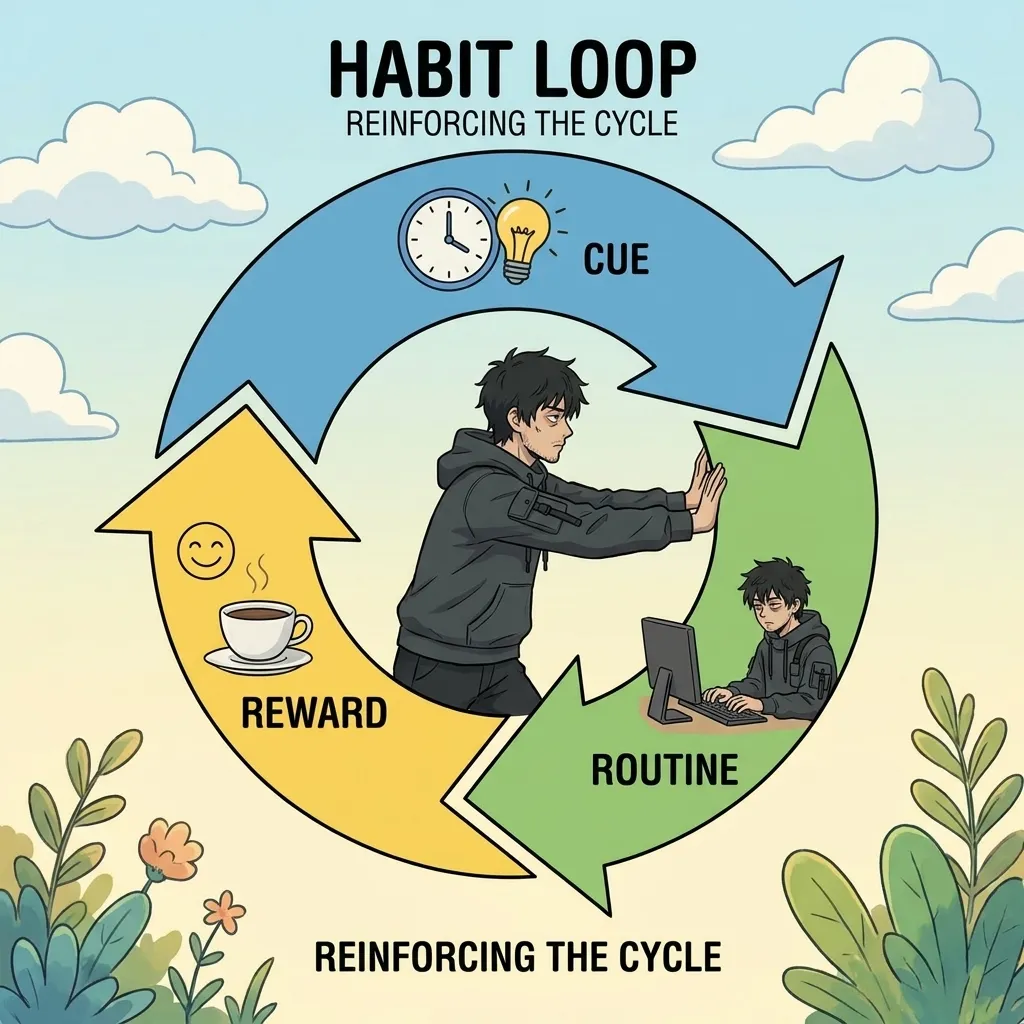
The habit loop, popularized by Charles Duhigg, consists of three core elements:
- Cue – the trigger that starts the behavior.
- Routine – the action you take.
- Reward – the benefit that reinforces the loop.
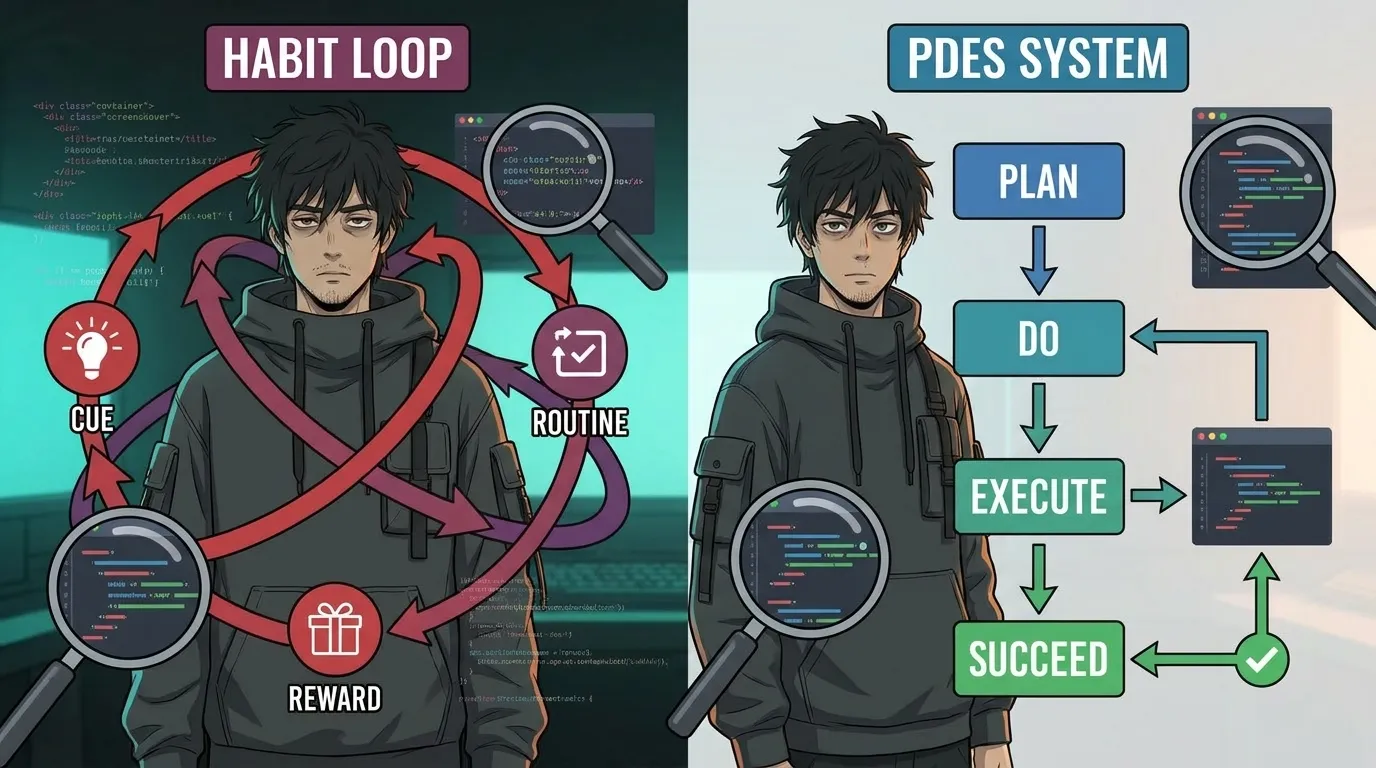
Habit Loop = Cue → Routine → Reward
Strengths:
- Simple to understand and apply.
- Excellent for quick, repetitive behaviors (e.g., brushing teeth, checking email).
Limitations:
- Ignores systemic context—cues and rewards can shift with environment.
- No built‑in measurement or optimization loop.
- Hard to scale to complex goals like career change or health transformation.
2. Introducing PDES: A Systemic Approach
PDES treats your life as a debuggable system. It runs through six phases that mirror a software development lifecycle:
- Perceive – Gather raw data, assess the current state.
- Model – Build a clear state‑machine map of the problem.
- Design – Create actionable frameworks and protocols.
- Build – Generate SOPs, trackers, and infrastructure.
- Measure – Apply Life Quant metrics (win rate, drawdown, Sharpe, etc.) to track KPIs.
- Optimize – Debug, refactor, and automate the habit loop.
PDES Cycle = Perceive → Model → Design → Build → Measure → Optimize (repeat)
Strengths:
- Handles changing cues and rewards by re‑perceiving the environment.
- Embeds measurement and optimization, turning habits into improvable processes.
- Scales from micro‑habits to life‑scale projects.
Learning curve:
- Requires a bit more upfront effort to model and measure.
- Once the system is in place, iteration becomes fast and data‑driven.
3. Side‑by‑Side Comparison: PDES vs Habit Loops
Here’s a direct comparison across five critical dimensions:
- Simplicity
Habit loops win on initial ease; PDES adds a modest learning curve but pays off with deeper insight. - Adaptability
When cues shift, habit loops break; PDES re‑enters the Perceive phase to update the model. - Measurement
Habit loops lack quantitative feedback; PDES integrates Life Quant metrics for objective tracking. - Optimization Loop
Habit loops rely on trial‑and‑error; PDES uses the Optimize phase to refactor and automate. - Scalability
Habit loops excel at single‑action routines; PDES scales to multi‑step projects, career pipelines, and health regimens.
If you want a quick fix for a simple behavior, start with a habit loop. If you want a debuggable, upgradeable system for any life goal, adopt PDES.
4. How to Apply the Comparison to Debug Your Life
Follow this 30‑minute debug protocol that leverages the strengths of both models:
- Perceive (5 min) – Write down the top three recurring frustrations you feel.
- Model (5 min) – For each frustration, sketch a simple habit‑loop diagram (Cue → Routine → Reward). Identify where the loop fails.
- Design (5 min) – Choose one frustration and replace the failing routine with a PDES micro‑process: define a clear Perceive step, a Model state, and a tiny Build action.
- Build (5 min) – Create a one‑page tracker (paper or digital) that logs your Perceive data and the outcome of your Build action.
- Measure (5 min) – After a day of tracking, calculate a simple success rate (e.g., # of successful builds ÷ total attempts). This is your first Life Quant metric.
- Optimize (5 min) – If the success rate is < 70 %, tweak the cue or the routine and repeat the cycle.
By the end of this loop, you’ll have:
- A clear view of what’s truly holding you back.
- A tested, improvable routine instead of a static habit.
- The foundation for scaling the same process to other life areas.
Summary: Why PDES Beats Habit Loops for Life Debugging
Habit loops give you a quick starter, but they lack the feedback and adaptation needed for lasting change. PDES adds perception, measurement, and optimization—turning every habit into a debuggable system. Use the habit loop as a stepping stone, then graduate to PDES for continuous, data‑driven improvement.
Click the button above to claim your guided session. You’ll identify your top three problems, isolate the root cause, and walk away with a personalized fix plan—all in under half an hour.