You’ve tried the tips, the templates, the quick fixes—yet real change feels elusive. What if you could treat your life like a codebase, debug it, and upgrade it systematically?
PDES (Personal Development Engineering System) applies computer science logic—think version control, modular architecture, and performance profiling—to self‑improvement. The following case study shows how one person moved from overwhelm to engineered growth using the 32‑level methodology.

1. Perceive: Diagnosing the Current State
The first phase, core_perceive, is an honest audit of where you stand. Instead of guessing, you collect data on habits, time, energy, and emotional states.
- List every recurring habit (morning routine, phone checks, exercise).
- Track time spent in 30‑minute blocks for a week.
- Rate energy levels (1‑10) after each major activity.
- Note moments of friction or procrastination.
dp/da = (Δ Success Probability) / (Δ Effort) – every action should yield a positive return on your probability of success.
2. Model: Turning Reality into a State Machine
With data in hand, core_model builds a finite state machine (FSM) that captures your typical modes of operation.
- Define discrete states (e.g.,
LowEnergy,Focused,Recovery). - Identify triggers that cause transitions (caffeine intake, meeting start, workout completion).
- Assign probabilities or frequencies to each trigger based on your logs.
- Draw the state diagram; visualize where you spend most time.
P(S_i → S_j) = f(trigger_i, context) – the probability of moving from one state to another is a function of the trigger and your current context.
3. Design: Creating Actionable Protocols
The core_design phase translates the model into concrete SOPs—daily, weekly, and monthly protocols that guide behavior.
- Morning Bootstrap Protocol – 5 min hydration, 5 min sunlight, 10 min movement, 10 min planning.
- Deep Work Sprint (90/20) – 90 min focused work, followed by 20 min deliberate recovery (walk, stretch, breath).
- Evening Shutdown Routine – review wins, log lessons, set tomorrow’s top three, lights out by 22:30.
Expected Value (EV) = Σ (Probability_outcome × Value_outcome) – each protocol is chosen because its EV exceeds the cost of execution.
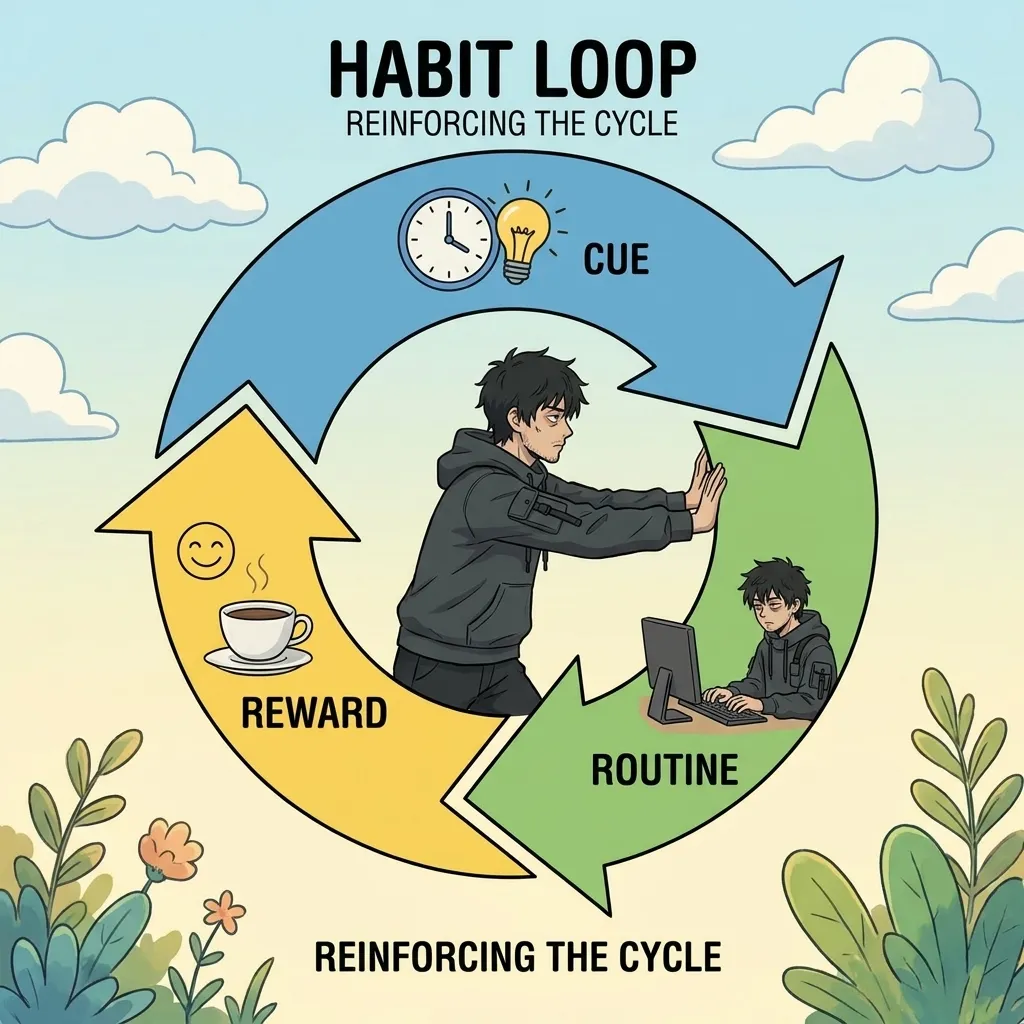
4. Build, Measure, Optimize: The Feedback Loop
core_build creates the tracking infrastructure, core_measure applies Life Quant metrics, and core_optimize runs Kaizen retrospectives to close the loop.
- Build a simple weekly tracker (Google Sheet or Notion) with columns for each state, time spent, and key outcomes.
- Measure Life Quant metrics each week:
- Win Rate = (successful sprints) / (total sprints)
- Drawdown = largest consecutive drop in energy score
- Sharpe Ratio = (Average daily energy – risk‑free) / std‑dev of energy
- Expectancy = (Win Rate × Avg gain) – ((1‑Win Rate) × Avg loss)
- Optimize via a 15‑minute retrospective: what worked, what didn’t, one tweak for next week.
Sharpe Ratio = (R_p – R_f) / σ_p – treat your energy return like an investment portfolio; higher Sharpe means more consistent, reliable performance.
Summary: From Chaos to Code
By perceiving, modeling, designing, building, measuring, and optimizing, you turn abstract aspirations into a debuggable system. Each iteration compounds—just like a software release—yielding measurable gains in productivity, energy, and fulfillment. The PDES 32‑level ladder provides the roadmap; the case study above shows the first successful deployment.
Ready to engineer your own transformation? Access the full Debug Protocol and start building your personal operating system today.