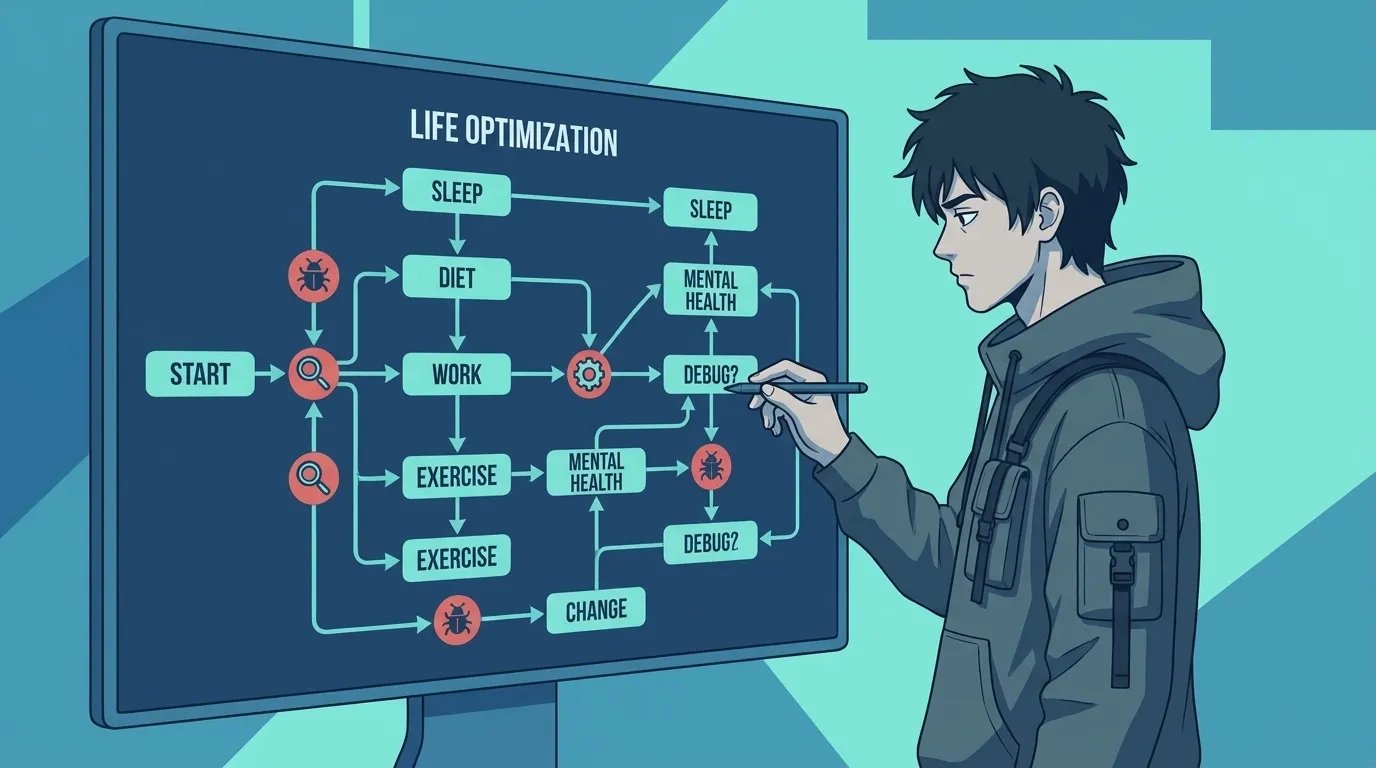
I hit a wall. After years of pushing hard in my career, I found myself exhausted, disengaged, and questioning whether the grind was worth it. That moment of burnout became the catalyst for a personal experiment: could I treat my life like a debuggable system?
Why Burnout Feels Like a System Crash
Burnout isn’t just “being tired.” It’s a signal that feedback loops have gone awry—energy drains faster than it’s replenished, recovery processes are blocked, and performance metrics plummet. In systems thinking, this mirrors a server overload where requests exceed capacity and caching fails.When your internal “throughput” drops below the incoming “request rate,” the system overheats.

Discovering PDES: The Debugging Framework
I stumbled upon the PDES (Personal Development Engineering System) framework, which applies computer science logic—perception, modeling, design, building, measuring, and optimization—to personal growth. The core idea: map your reality to a state machine, identify bugs, and deploy patches.
- Perceive: Gather honest data about energy, mood, time usage, and stressors.
- Model: Draft a simple flow—wake → work → recovery → sleep—and flag where the loop breaks.
- Design: Create protocols (e.g., mandatory 10‑minute micro‑breaks, hard shutdown at 7 pm).
- Build: Turn protocols into SOPs and habit trackers.
- Measure: Apply Life Quant metrics—win rate, drawdown, expectancy—to daily execution.
- Optimize: Review metrics weekly, refactor failing habits, and reinforce wins.
Mapping Life Problems to Computer Science Concepts
PDES includes a 32‑level ladder where each life challenge maps to a CS concept, and each concept has a fix protocol.
My burnout aligned closely with three levels:
Level – Thread (): My attention was split across too many concurrent threads (projects, emails, social media) without proper synchronization, causing context‑switch overhead and mental fatigue.
Level – Virtual (Cloud): I relied on “virtual” resources—willpower and motivation—as if they were infinite, ignoring the need for real‑world allocation (sleep, nutrition, recovery).
Level – Compiler: My mental “compiler” turned intentions into actions with many warnings and errors (procrastination, self‑doubt), lowering the signal‑to‑noise ratio of productive output.
For each, I applied the corresponding fix protocol:
Thread Fix: Instituted a strict “single‑thread” work block (90 min focus, then a hard break) and used a simple mutex—only one major project active at a time.
Virtual Fix: Treated energy like a finite CPU budget, allocating cycles to recovery (sleep, walks, hobbies) before spending on work.
Compiler Fix: Added a “linting” step each morning—review intentions, clear mental clutter, and set clear, compilable goals for the day.
Measuring Progress with Life Quant
I tracked five core Life Quant metrics weekly:
- Win Rate: % of days I hit my micro‑break and shutdown targets (rose from 35 % to 78 % in six weeks).
- Drawdown: Peak‑to‑trough dip in daily energy score (reduced from −42 to −12).
- Expectancy: Average energy gain per planned recovery activity (increased from +0.8 to +2.1 points).
- Sharpe Ratio: Return (energy gain) versus volatility (day‑to‑day swings) improved from 0.4 to 1.2.
- Profit Factor: Ratio of productive hours to total hours (went from 0.6 to 0.85).
Results: From Crash to Stable Operation
After eight weeks of iterating through the PDES loop:
Energy: Baseline energy score climbed from 48/100 to 71/100.
Productivity: Deep‑work hours per week rose from 10 to 22 without increasing total work time.
Well‑Being: Self‑reported stress dropped 40 %; anxiety incidents fell from daily to twice weekly.
Systems Thinking: I now instinctively pause, perceive, model, and debug before reacting—a habit that transfers to any challenge.
How You Can Start Debugging Your Own Life
You don’t need a perfect system to begin. Follow this quick start:
- Perceive: Log your energy, mood, and key activities for three days (simple spreadsheet or notes).
- Model: Sketch a basic flow—wake → work → recovery → sleep—and mark where you feel the most friction.
- Design: Pick ONE friction point and write a tiny SOP (e.g., “shut down laptop by 7 pm, no email after”).
- Build: Put that SOP into a habit tracker (paper or app) and commit to it for seven days.
- Measure: At the end of the week, calculate a simple win rate (days you hit the SOP ÷ 7).
- Optimize: If win rate < 70 %, tweak the SOP (make it easier or adjust timing) and repeat.
Each iteration tightens the feedback loop, reduces bugs, and upgrades your internal operating system.
Take the Next Step: Free Debug Protocol Cheat Sheet
To make this process even easier, I’ve distilled the entire 32‑level mapping and fix protocols into a single, printable cheat sheet. It shows every common life problem, its CS counterpart, and the exact protocol to apply.
Grab it, start debugging, and watch your life shift from constant crashes to smooth, optimal performance.
Remember: Your life is a system. Treat it like one, and you’ll finally stop merely surviving—and start thriving.