Your Life Has Bugs. Here’s the Debugger.
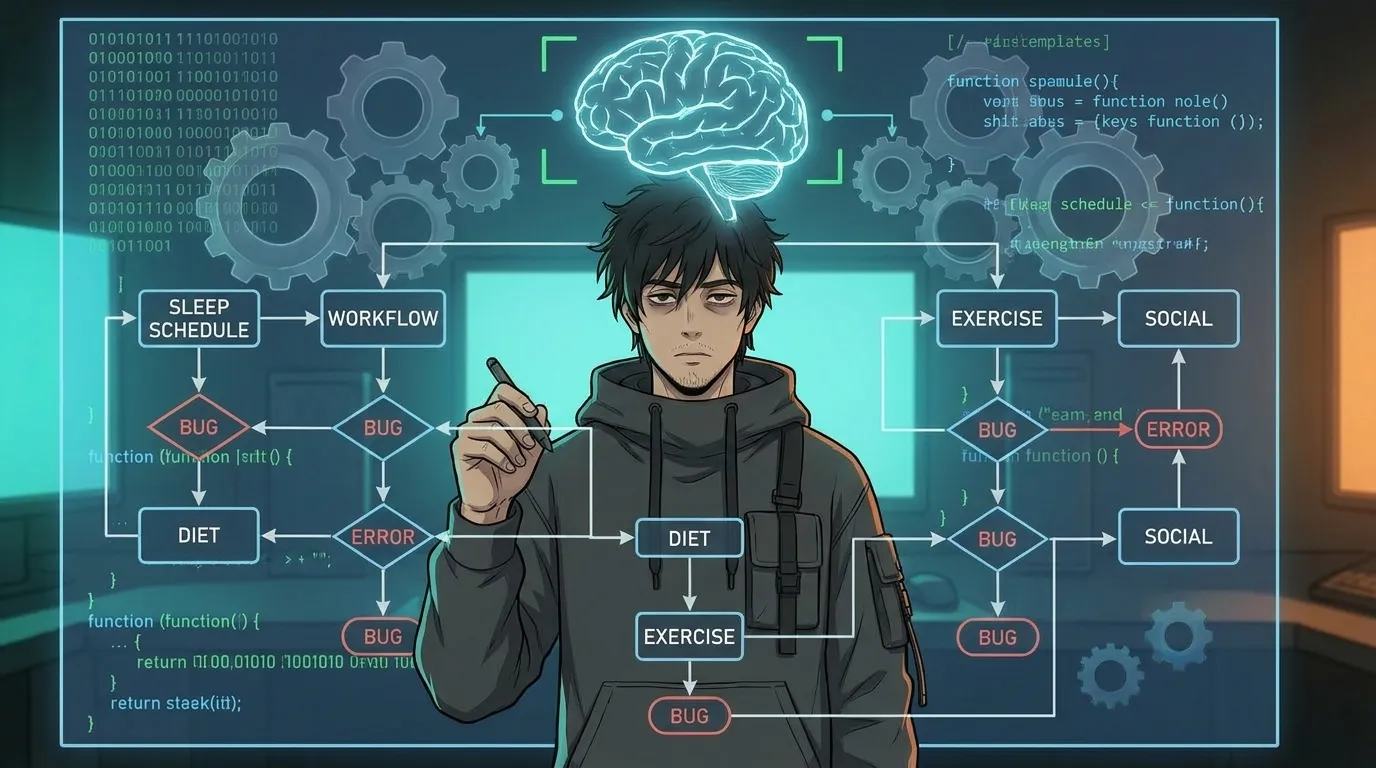
Every system has bugs. Your computer has bugs. Your smartphone has bugs. And yes—your life has bugs too.
The difference between people who thrive and people who struggle isn’t that one person has fewer bugs. It’s that one person knows how to debug their system while the other keeps running broken code.
Today, I’m going to show you a 5-level debugging protocol that will help you find what’s broken, isolate the cause, and fix it—using the same logic that runs every computer on the planet.
Why Your Life Needs Debugging
Think about your last month. How many times did you:
- Start something with enthusiasm, then abandon it
- Repeat the same mistake despite promising yourself you wouldn’t
- Feel stuck in a pattern you can’t seem to break
- Wonder why you keep getting the same results
These aren’t character flaws. They’re bugs in your personal development system.
Just like software bugs, life bugs follow predictable patterns. They have causes, symptoms, and solutions. And just like software engineers, you can systematically identify and fix them.

The 5-Level Debugging Protocol
This protocol is based on the same principles that computer scientists use to debug complex systems. But instead of fixing code, you’ll be fixing your life.
Level 1: Error Detection – Finding the Crash
Before you can fix anything, you need to know what’s broken. This is error detection.
Error Detection Formula:
Problem + Pattern + Pain = Bug Found
Ask yourself:
- What keeps happening that I don’t want?
- When does this problem occur most frequently?
- What’s the cost of this bug in terms of time, energy, or happiness?
Example: “I keep missing deadlines on important projects. This happens every time I have multiple priorities. The cost is stress, lost opportunities, and damaged reputation.”
Level 2: Reproduction – Isolating the Conditions
Once you’ve identified a bug, you need to reproduce it. Not to make it worse, but to understand exactly when and how it occurs.
Reproduction Protocol:
Situation + Trigger + Response = Bug Reproduction
Document the exact conditions that cause the bug:
- What specific situation triggers this problem?
- What’s the immediate trigger that sets it off?
- What’s my automatic response?
Example: “When I have 3+ urgent tasks (situation), and I receive an unexpected request (trigger), I immediately switch focus and lose track of my priorities (response).”
Level 3: Root Cause Analysis – Finding the Core Bug
This is where most people fail. They treat symptoms instead of causes. Root cause analysis digs deeper.
Root Cause Formula:
Symptom → Immediate Cause → Underlying Cause → Core Bug
Keep asking “why” until you reach the fundamental issue:
- Why did this happen? (Immediate cause)
- Why does that cause exist? (Underlying cause)
- Why is that underlying cause present? (Core bug)
Example: “I miss deadlines (symptom) because I take on too much (immediate cause) because I can’t say no (underlying cause) because I fear disappointing others (core bug).”
Level 4: Solution Design – Writing the Patch
Now you design the fix. This is your patch—the specific code that will eliminate the bug.
Patch Design Framework:
If [condition], then [action] instead of [current response]
Create specific, actionable rules:
- If [trigger occurs], then I will [new action] instead of [old response]
- The new action must address the core bug, not just the symptom
- The patch should be simple enough to remember under stress
Example: “If I receive an unexpected request when I have 3+ urgent tasks, then I will say ‘I’ll check my calendar and get back to you in 24 hours’ instead of immediately saying yes.”
Level 5: Implementation & Testing – Running the Debug
The final level is where theory meets reality. You implement your patch and test whether it works.
Testing Protocol:
Implement → Monitor → Measure → Iterate
Track your results:
- How often does the bug still occur?
- What’s different about the situations where the patch works?
- What needs to be adjusted for better results?
Remember: The first patch rarely works perfectly. Debugging is iterative. You refine until the bug is eliminated.
Real-World Application: The 30-Day Debug Challenge
Ready to debug your life? Here’s a 30-day challenge to get you started:
- Week 1: Error Detection – Document every “bug” you encounter. No fixing, just detection.
- Week 2: Reproduction & Root Cause – Pick your biggest bug and trace it to its core cause.
- Week 3: Solution Design – Create your patch for that core bug.
- Week 4: Implementation & Testing – Implement and refine your patch.
By the end of 30 days, you’ll have eliminated at least one major life bug and learned the debugging process that you can apply to any problem.
The System Behind the Debugging
The debugging protocol is powerful, but it’s just one layer of a complete personal development system. To truly transform your life, you need multiple interconnected systems working together.
That’s why I created the Personas Development Engine System (PDES) —a 6-layer framework that includes:
- Core Layer: Your fundamental values and purpose
- Insight Layer: How you perceive and interpret reality
- Protocol Layer: Your debugging and optimization processes
- Engine Layer: Your daily habits and routines
- Refine Layer: Your continuous improvement mechanisms
- Horizon Layer: Your long-term vision and strategy
The debugging protocol you just learned is part of the Protocol Layer—but it’s most powerful when integrated with the other five layers.
Your Next Step: Get the Basic 5 ALgo Toolkit
You now have the core debugging protocol, but to truly transform your life, you need the complete system. The Basic 5 ALgo Toolkit gives you:
- The complete 5-level debugging protocol.
- The first 5 levels overall 32 levels framework overview to see how debugging fits into your complete system
- Additional core algorithms for habit formation, decision making, and goal achievement
- Implementation templates and tracking tools
This toolkit is completely FREE, and it’s the first step toward building a life that runs smoothly, efficiently, and powerfully.
Your life has bugs. But now you have the debugger. The question is: are you ready to start fixing them?
Remember: Every great system started with debugging. Your life is no different.