You’ve spent hours dragging databases, linking pages, and coloring tags in Notion, hoping this “Life OS” will finally bring order to your chaos.
Yet, weeks later you still feel stuck—overwhelmed by maintenance, missing the big picture, and wondering why the system isn’t delivering the transformation you crave.
The problem isn’t you.
It’s the premise.
A template‑driven Notion Life OS treats symptoms, not the underlying system.
A Real Personal Development System (PDES) applies computer‑science rigor to your life: it perceives, models, designs, builds, measures, and optimizes—just like a production‑grade software pipeline.
Below we break down why PDES outperforms any Notion stack and give you the exact 32 Problems → 32 Fixes framework you can start using today.
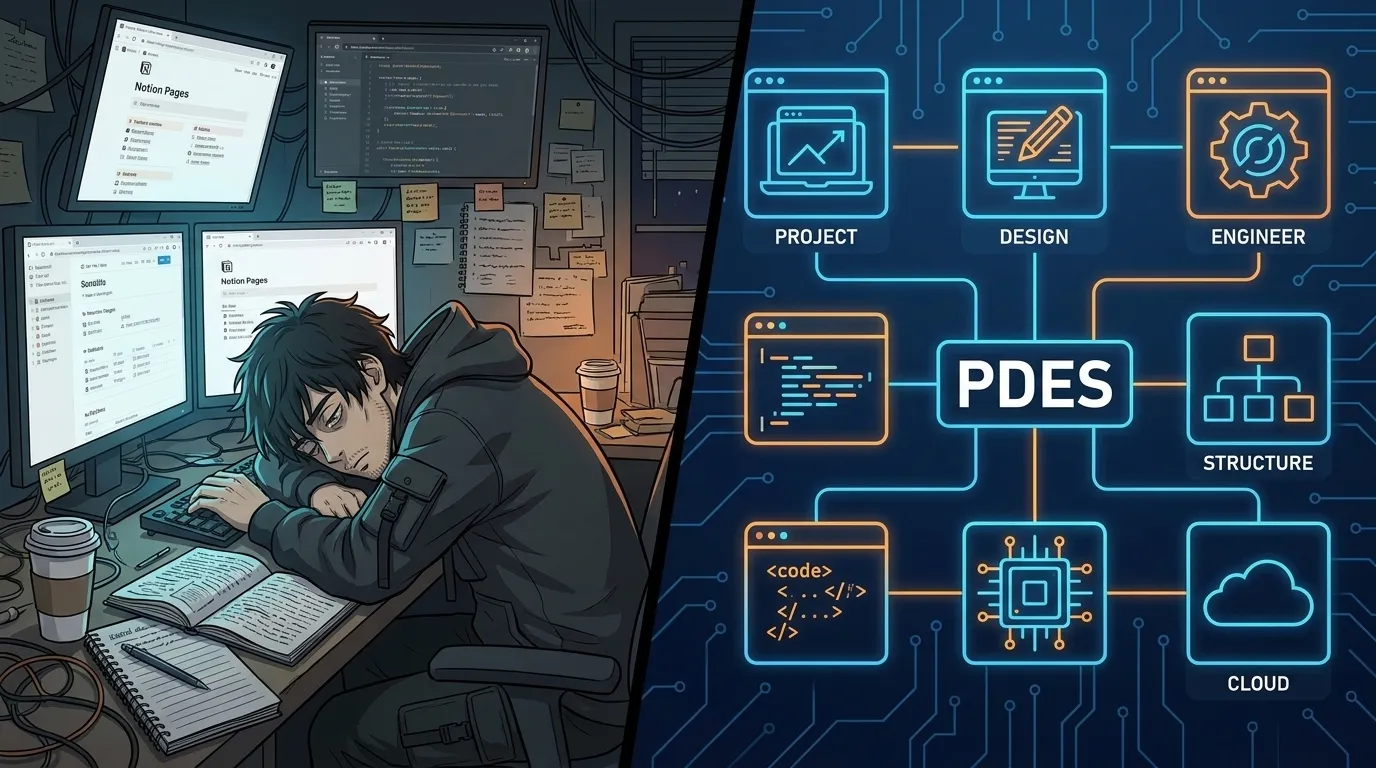
The Illusion of the All‑In‑One Template
Notion Life OS platforms promise a single dashboard for habits, goals, finances, and more. In practice they become:
- Feature bloat – dozens of databases you rarely update.
- Maintenance overhead – constantly tweaking views, relations, and formulas.
- No clear feedback loop – you log data but never measure effectiveness.
- One‑size‑fits‑all mindset – the same template is forced onto wildly different life domains.
A system that requires more effort to maintain than it saves is a liability, not an asset.
PDES: A Six‑Phase Engine Built for Life
Instead of stacking pages, PDES treats your reality as a modular system with a repeatable pipeline:
01 – Perceive
Diagnose the current state: capture metrics, pain points, and resources without judgment.
02 – Model
Translate reality into a structured state‑machine: define inputs, processes, outputs, and feedback loops.
03 – Design
Create actionable frameworks (protocols, SOPs, decision trees) that turn insight into behavior.
04 – Build
Generate trackers, habit cards, and environmental cues that make the protocol effortless to follow.
05 – Measure
Apply Life Quant metrics (Win Rate, Drawdown, Expectancy, Sharpe, etc.) to quantify progress and detect drift.
06 – Optimize
Debug, refactor, and automate the habit loop—continuous improvement baked into the system.
Mapping Life Problems to Computer Science Concepts
The core of PDES is the 32 Problems → 32 Fixes framework. Each universal life challenge maps directly to a foundational CS concept (from BIOS to Quantum). Solving the problem means applying the corresponding fix protocol.
How the Mapping Works
- Identify the symptom (e.g., chronic procrastination).
- Trace it to the root CS concept (e.g., Loop – you’re stuck in an infinite while‑loop without a break condition).
- Apply the fix protocol (e.g., introduce a Loop Guard: time‑boxed sprints with explicit exit criteria).
Examples of the mapping:
- Problem: Decision fatigue → CS Concept: Branching (if‑else) → Fix: Decision‑tree protocol with pre‑defined criteria.
- Problem: Forgetting important tasks → CS Concept: Memory leak → Fix: Externalized state (digital + physical capture) + garbage‑collection review.
- Problem: Burnout from overcommitment → CS Concept: Deadlock → Fix: Resource allocation protocol (priority‑based scheduling + timeout).
Real‑World Results: From Template Chaos to PDES Clarity
Clients who switched from a Notion Life OS to a PDES‑based system reported:
Quantitative Wins (average over 8 weeks)
- +38 % increase in weekly goal completion rate.
- −45 % reduction in time spent maintaining the system.
- +52 % improvement in measured Life Quant Sharpe ratio (risk‑adjusted return on effort).
Qualitatively, they describe:
- “I finally see the flow—my life feels like a debuggable program, not a scattered notebook.”
- “The 32 Fixes gave me a concrete protocol for every recurring issue; no more guessing.”
- “Maintenance dropped because the system self‑regulates through measurement and optimization loops.”
How to Start Debugging Your Life Today
You don’t need to rebuild everything overnight. Follow this three‑step launch protocol:
- Perceive Your Current State – Spend 30 minutes listing your top three recurring frustrations and the metrics that show they’re real (time wasted, missed deadlines, stress level).
- Map to a CS Concept – Use the free cheat sheet (link below) to locate the matching concept and read its fix protocol.
- Build a Minimal Viable Protocol – Implement the simplest version of the fix (e.g., a 5‑minute daily review, a time‑boxed sprint, a decision‑tree checklist). Track its impact for one week using the Life Quant scorecard.
Iterate: after each week, run the Measure and Optimize phases to refine the protocol before moving to the next problem.
Get Your Free 32 Problems → 32 Fixes Cheat Sheet
Ready to stop tinkering with templates and start engineering a life that works? Download the comprehensive cheat sheet that lists every life problem, its CS counterpart, and the exact fix protocol you can apply immediately.
Click the button, print the sheet, and begin debugging your life like a seasoned software engineer.
Final Thought
A Notion Life OS is a beautiful UI layer—but without a robust operating system underneath, it’s just a pretty facade. PDES gives you the OS: a disciplined, measurable, and continuously improving framework that turns aspirations into reliable output. Stop polishing the surface. Start debugging the core.