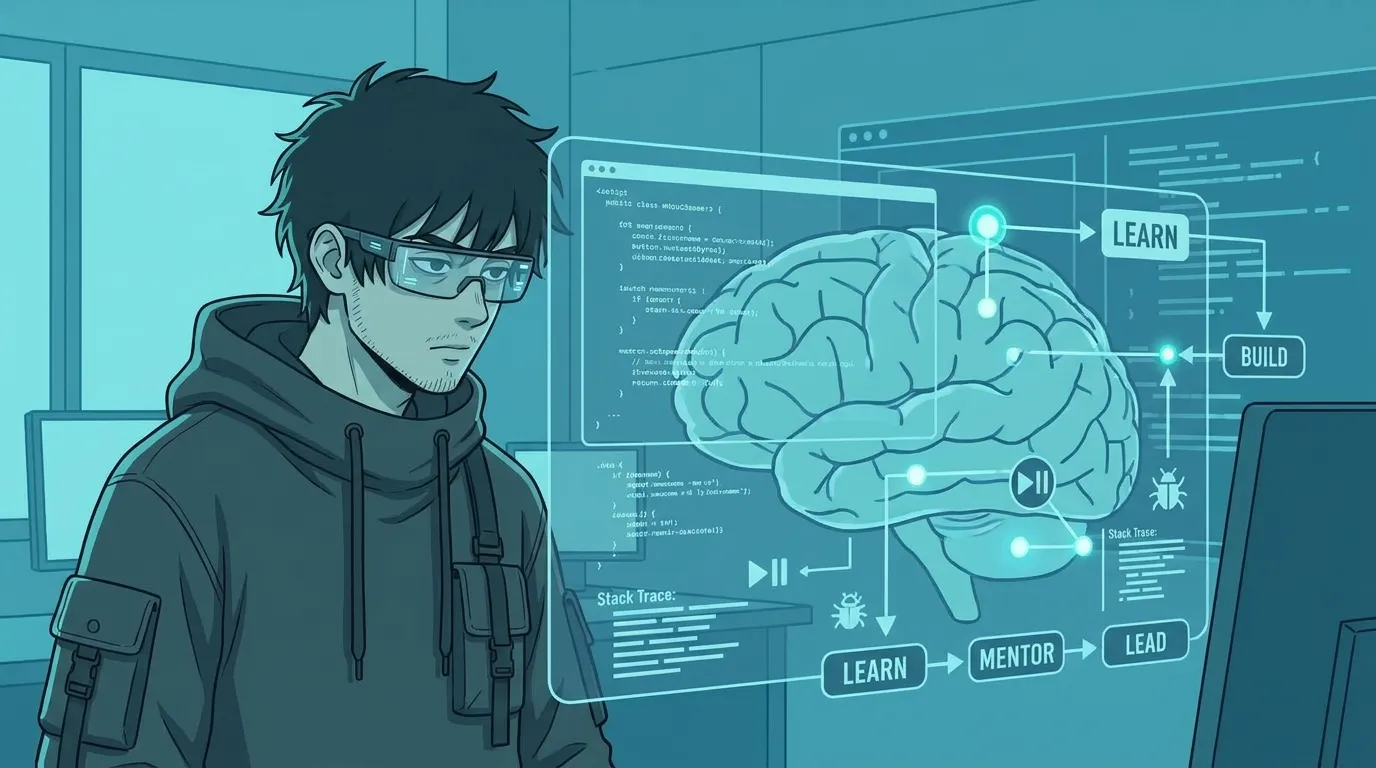
In the intricate operating system of your life, communication often acts as a critical interface.
When this interface encounters a problem, the symptom manifests as social awkwardness, misunderstandings, or a general inability to connect effectively.
For analytical thinkers, these glitches can be particularly frustrating, feeling like a perpetual bug in their personal code.
But what if these social hiccups aren’t just personality quirks, but rather Syntax Errors in your behavioral ALgorithm?
The Personal Development Engineering System (PDES) posits that your reality is a modular system, ready to be perceived, modeled, designed, and optimized.
Just as Partial Differential Equations (PDEs) model how complex multi-variable systems change over time, PDES allows you to apply Computer Science logic and System Engineering methodologies to your personal development.
It’s about turning your life into a debuggable, optimizable system using the same logic that runs every computer.
Our principle: “The index is the map that enables navigation through the territory of self-optimization.”
Today, we will delve into how to debug communication syntax error within your habits, transforming social awkwardness and poor communication into opportunities for systematic self improvement.
We will treat communication not as an art, but as a system with identifiable inputs, processes, and outputs, ready for optimization.
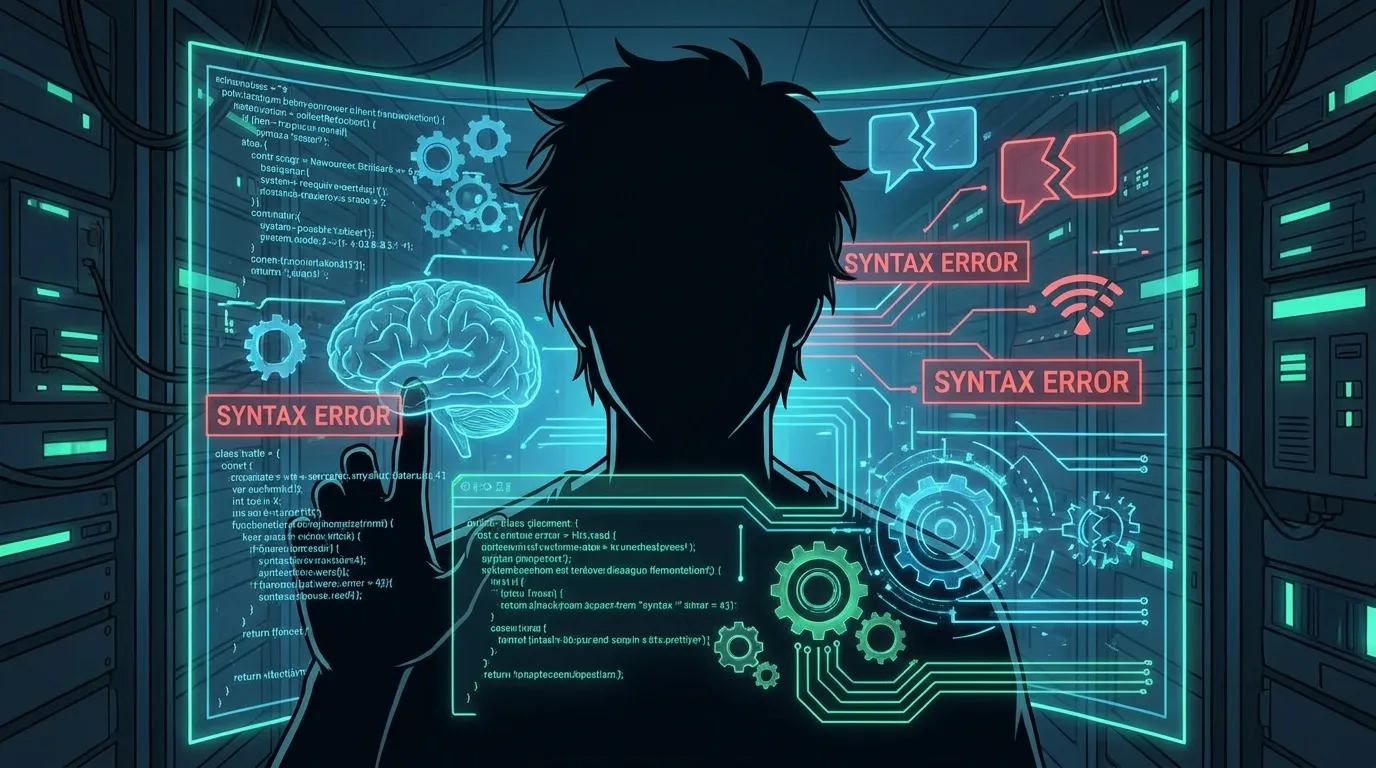
The [Syntax Error] in Human Interaction: Understanding G1=Syntax
Imagine writing a program.
Every command must adhere to a specific structure, a “syntax.”
A misplaced comma, a forgotten bracket, or an incorrect keyword results in a Syntax Error—the program simply won’t run.
In the PDES framework, especially at Level G1=Syntax, we understand that human communication operates on a similar principle.
Our words, gestures, tone, and body language form a “social syntax.”
When these elements are misaligned, unclear, or misinterpreted, they create a “communication syntax error,” leading to social awkwardness and ineffective exchanges.
This isn’t about being “wrong”; it’s about failing to conform to the expected format of interaction, causing the “social program” to crash or produce unexpected results.
For instance, giving a one-word answer when an elaborate explanation is expected, or vice versa, is a syntax mismatch.
Failing to make eye contact when culturally appropriate, or displaying contradicting non-verbal cues (e.g., saying “yes” while shaking your head), are all forms of social syntax errors.
They disrupt the smooth processing of information, leading to friction and misunderstanding.
At the heart of resolving these issues lies the concept of “Emotional Granularity.”
Just as code needs precise Syntax to convey meaning, emotions need clear definitions and expressions to be understood.
Vague feelings can cause “system crashes” in your social interactions.
PDES helps you upgrade your Syntax to emotional granularity, mapping your internal states (your biological hardware’s “memory”) to precise data points for better decision precision in your interactions.
Why [Analytical Thinkers] Struggle with Social `ALgorithms`
Analytical thinkers often excel in environments where rules are explicit, logic is king, and outcomes are predictable.
Mathematics, engineering, computer science—these are domains of pure logic.
Social interactions, however, are often governed by implicit rules, fuzzy logic, and unpredictable human emotions.
This stark contrast makes navigating social “ALgorithms” a unique challenge.
Our minds are wired for efficiency.
When confronted with a problem, an analytical thinker will often try to apply a precise, deterministic solution.
They seek the optimal path, the perfect logical statement.
However, social dynamics are rarely optimal or perfectly logical.
There’s an underlying “social operating system” that relies on intuition, empathy, and pattern recognition—skills that are often not explicitly taught or highly valued in purely technical fields.
The struggle often arises because “social code” is highly contextual and adaptive.
What works in one social “environment” (e.g., a professional meeting) may cause a critical “error” in another (e.g., a casual family gathering).
This lack of universal Syntax and Variables can be frustrating for someone accustomed to explicit system rules.
They might perceive nuanced cues as noise, leading to misinterpretation or an inability to formulate an appropriate “response ALgorithm.”
This is where system thinking applied to personal development offers a powerful advantage: it provides a framework to perceive, model, and design these “fuzzy” systems.
Perceive: Identifying Your Communication Bugs with `core_perceive`
The first step in debugging any system is to thoroughly perceive and diagnose the current state. In PDES, this is the function of the core_perceive phase.
For communication, this means actively observing and documenting your “communication bugs” without judgment. Remember, DATA, OPTIMIZE, LOAD. You must gather the “DATA” first.
Ask yourself: What are the common symptoms of my communication syntax errors?
- Do conversations frequently stall or feel awkward?
- Are my intentions often misunderstood?
- Do I struggle to articulate complex thoughts clearly?
- Do I get easily overwhelmed in group discussions?
- Do I receive feedback (explicit or implicit) that I’m “hard to read” or “too direct”?
To quantify these observations, PDES employs “Life Quant” metrics—applying 10 trading metrics to daily execution. For communication, consider:
- Win Rate: What percentage of your interactions achieve their intended outcome (e.g., clear understanding, positive connection)?
- Drawdown: How much “social capital” do you lose from misunderstandings or awkward encounters?
- Opportunity Cost: What social or professional opportunities are you missing due to ineffective communication?
Begin a “bug log” for your social interactions. After each significant conversation, take a moment to reflect: What went well? Where did it “glitch”? What was the “error message” (e.g., confused look, abrupt topic change, defensive response)? This empirical approach to self-observation is crucial for building a solid foundation for self improvement.
Model: Structuring Social `ALgorithms` with `core_model`
Once you have perceived the symptoms, the next step is to transform your reality into a structured system state machine flow. This is the core_model phase in PDES. We begin to see social interactions not as chaotic events, but as ALgorithmic processes with discernible Variables and conditional Logic.
Every social interaction has “Variables” (Level G2). These include:
- Context: Where is the interaction happening? (e.g., a formal meeting, a casual dinner, online chat).
- Participants: Who are you talking to? What are their roles, personalities, and emotional states?
- Objective: What is the purpose of the interaction? (e.g., inform, persuade, connect, resolve conflict).
By identifying these Variables, you can start to anticipate different “branches” in the social ALgorithm. For example, your “greeting ALgorithm” will change based on whether the Variable “Person Type” is “Boss,” “Friend,” or “Stranger.”
The importance of “Input/Output” (Level G6) cannot be overstated here. Communication is a feedback loop. Your “input” (what you say or do) generates an “output” (the other person’s reaction). This output then becomes the “input” for your next action. A common communication syntax error for analytical thinkers is to treat communication as a one-way broadcast rather than a dynamic, interactive process. Modeling helps you recognize and optimize these feedback loops.
Consider a simple social scenario as a state machine:
STATE: Initial Greeting
  IF (Context == Formal) THEN (Output: "Good morning, [Name]")
  ELSE IF (Context == Informal) THEN (Output: "Hey, [Name]!")
  ELSE (Output: "Hello")

STATE: Receive Response
  IF (Response == Positive) THEN (Transition to: Small Talk)
  ELSE IF (Response == Neutral) THEN (Transition to: Topic Introduction)
  ELSE (Transition to: Clarification/Re-evaluate)
While this might seem overly simplistic, the act of attempting to model these interactions forces you to think systematically about communication, making the implicit explicit. This is crucial for self improvement in social settings.
Design: Crafting Your Communication Protocols for [Self Improvement] with `core_design`
With your communication bugs identified and interactions modeled, you can now enter the core_design phase. This is where you create actionable frameworks and protocols to address your identified syntax errors. For analytical thinkers, this means leveraging your strength in structured thinking to build effective communication “scripts” or “protocols.”
The core of this design process is applying Logic (Level G5) to your social interactions. This means deliberately choosing your words, tone, and non-verbal cues to achieve a specific outcome. It’s about making conscious, logical decisions in real-time, rather than relying on unexamined habits or instinct.
The “dp/da” (partial differential equations) investment filter becomes critical here: ensuring every communication action you take increases your probability of success or reduces your cost (e.g., avoids misunderstanding, saves time, builds rapport). Before you speak, quickly run a mental “check:” Will this statement move me closer to my objective or further away? Is there a more efficient “path”?
The `ALgorithm` of Effective Dialogue: From `Loops` to `Objects`
Our journey through PDES reveals how deeper Computer Science concepts offer profound analogies for self improvement:
- `Loops` (Level G3): Do you find yourself in repetitive negative interaction patterns? Perhaps you always interrupt, or always shut down when challenged. These are “infinite loops” of ineffective behavior. Designing new protocols means implementing “exit conditions” for these loops, consciously breaking the cycle. For example, if you realize you often interrupt, your new protocol might be: “Detect urge to interrupt → Force self to count to three → Acknowledge speaker → Formulate response.”
- `Memory` (Level G4): Effective communication relies on a robust “social memory.” Remembering past conversations, preferences, and sensitivities of others allows you to tailor your `Syntax` and `Variables` for maximum impact. A common communication syntax error is failing to load relevant “memory” before an interaction, leading to generic or inappropriate responses.
- `Object` (Level G7): In object-oriented programming, “objects” are self-contained entities with properties and methods. We can think of people as complex “objects.” Each person has unique “properties” (personality traits, values, beliefs) and “methods” (how they typically communicate, react, and process information). Understanding these allows you to interact with them more effectively, anticipating their “behavior” and adapting your “input” accordingly. This fosters greater empathy and more effective negotiation, essential for system thinking in social contexts.
By designing explicit communication protocols, you replace reactive, buggy behaviors with proactive, optimized “code.” This systematic approach is a cornerstone of PDES for sustained self improvement.
Build & Measure: Implementing and Tracking Your Social Patches with `core_build` & `core_measure`
Designing protocols is merely the blueprint; the real transformation occurs in the core_build and core_measure phases. Here, we generate Standard Operating Procedures (SOPs), trackers, and infrastructure, then apply “Life Quant” metrics and track Key Performance Indicators (KPIs).
Building new communication habits requires deliberate practice. Your “SOP” for a common social scenario (e.g., introducing yourself, asking for a favor, resolving a conflict) should be clear and concise. This isn’t about being robotic; it’s about creating a reliable “default ALgorithm” that you can then adapt and improvise upon. Practice these protocols in low-stakes environments first.
The core_measure phase provides the feedback necessary for optimization. This means actively tracking your progress using “Life Quant” metrics relevant to social interactions:
- Positive Feedback Rate: How often do you receive explicit or implicit positive responses (e.g., laughter, agreement, further engagement)?
- Engagement Duration: How long do conversations last? (If appropriate for your goal.)
- Clarity Score: On a scale of 1-10, how clearly did you convey your message? (Self-assessed or, if possible, through direct feedback.)
- Misunderstanding Reduction: Track instances of miscommunication. Is the frequency decreasing?
The “Input/Output” (Level G5) concept is crucial here. Focus on the observable “output” from your “inputs.” If your intended message (“input”) results in a confused look (“output”), you know there’s a syntax error that needs debugging. This systematic tracking allows you to move beyond subjective feelings of social awkwardness to objective data points, driving your self improvement.
Optimize: Refactoring Your Social Code with `core_optimize`
The final, continuous phase in PDES is core_optimize. This is where you debug, refactor, and automate your habit loops. Just like a developer constantly refines code, you will continuously improve your communication “ALgorithms.”
Debugging: When a communication bug is detected (e.g., a low “Win Rate” in your Life Quant metrics), you systematically isolate the cause. Was it a specific word choice (Syntax)? A misjudgment of the other person’s context (Variables)? A faulty logical step in your argument (Logic)? Use your bug log to pinpoint common failure modes.
Refactoring (Source – Level G24): “Refactoring” in software development means restructuring existing code without changing its external behavior, to improve its readability, maintainability, or efficiency.
In communication, this means re-examining your core beliefs and automatic responses (your “source code”) that lead to communication syntax errors. Instead of just patching symptoms, you’re changing the underlying structure of your social “code.” For instance, if you constantly make assumptions about others, refactoring might involve implementing a “question-first” protocol.
Automating Positive Social ALgorithms (Optimizing the Habit Loop): The ultimate goal is to integrate effective communication patterns so deeply that they become second nature. This doesn’t mean becoming rigid; it means freeing up cognitive resources. When your foundational social syntax is solid, you can devote more mental energy to empathy, creativity, and deeper connection, rather than constantly worrying about missteps. This is where system thinking transforms into seamless execution.
Continuous feedback loops, powered by core_measure data, allow for iterative refinement. Each interaction becomes a new data point, feeding into the optimization cycle. You become a “compiler” for your own social ALgorithms, continuously improving your personal “operating system.” This robust process ensures sustainable self improvement, turning communication challenges into debuggable puzzles that empower analytical thinkers to thrive in any social environment.
Conclusion: Compile Your Social Competence
Social awkwardness and poor communication are not permanent features of your identity; they are “syntax errors” in your personal operating system that can be systematically debugged and refactored. By applying the rigorous, logical framework of PDES, analytical thinkers can bridge the gap between their technical prowess and their social interactions. This unique blend of CS meets PD provides a powerful pathway to profound self improvement.
Through the phases of core_perceive, core_model, core_design, core_build, core_measure, and core_optimize, you gain unparalleled agency over your communication habits. You learn to DATA, OPTIMIZE, LOAD your social interactions, transforming ambiguity into clarity and friction into connection. The index truly is the map that enables navigation through the territory of self-optimization.
Ready to Debug Your Internal Communication System?
Vague feelings cause system crashes. Upgrade to Syntax (Emotional Granularity) to map your somatization (Memory) to data points for better decision precision.