Stuck in the cycle of “I’ll start tomorrow”? You’re not lazy—you’re fighting a brain wired for immediate relief, not long‑term gain. The good news: habit building for procrastinators works when you design systems that bypass willpower entirely.
This guide translates the core loop of habit formation into a practical, step‑by‑step framework you can apply today—no motivation required.
1. Why Willpower Fails the Procrastinator’s Brain
Procrastination isn’t a character flaw; it’s a mismatch between your environment and your brain’s reward system. When a task feels vague or aversive, the amygdala triggers avoidance, while the prefrontal cortex—responsible for planning—gets drowned out.
- Instant gratification bias: Your brain prefers quick relief over delayed benefits.
- Decision fatigue: Each vague “should I start?” query drains mental energy.
- Willpower is a limited resource: Relying on it guarantees burnout after a few attempts.
Instead of fighting these tendencies, we design habit loops that make the desired action the path of least resistance.
2. Building Willpower‑Free Habit Loops
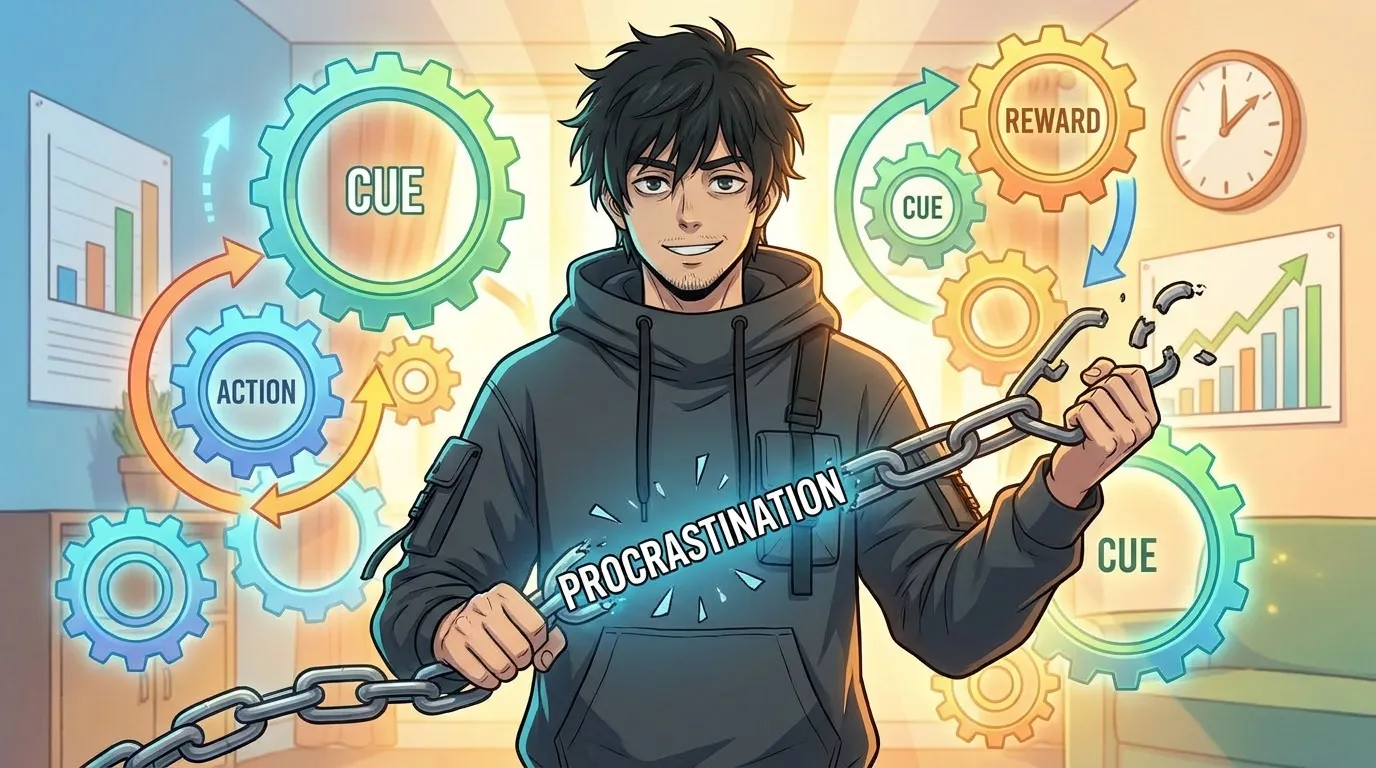
The classic habit loop consists of three elements: Cue → Routine → Reward. For procrastinators, we tweak each piece to eliminate the need for self‑control.
- Make the cue obvious and unavoidable: Pair the new habit with an existing, non‑negotiable routine (e.g., “After I brush my teeth, I will…”).
- Shrink the routine to a “micro‑action”: Start with a version so tiny it feels almost laughable (e.g., “Put on my running shoes” instead of “Run 3 miles”).
- Deliver an immediate, satisfying reward: Give yourself a micro‑celebration— a favorite song, a 30‑second stretch, or a tick on a visual streak chart.
When the routine requires less than 20 seconds of effort and the reward follows instantly, the brain registers the loop as “worth doing” without invoking willpower.
3. Tiny‑Start Systems: From Idea to Action
Implementation is where most plans falter. Follow this three‑step launch protocol to turn intention into automatic behavior.
- Identify the micro‑action: Choose the smallest possible step that still moves you toward the goal (e.g., “Open the document and write one sentence”).
- Anchor it: Write a concrete “after [X] I will [Y]” statement and place it where you’ll see the cue (on your bathroom mirror, phone lock screen, etc.).
- Log the win: Use a simple habit tracker— a paper chain, a phone note, or a spreadsheet column— marking each successful completion. The visual streak itself becomes a reward.
Repeat this cycle for 21‑30 days. By then the loop is wired, and you can gradually increase the micro‑action’s difficulty.
4. Measuring Progress & Optimizing with Life Quant
Optimization requires data. Apply five core Life Quant metrics to your habit experiment:
- Win Rate: % of days you completed the micro‑action.
- Current Streak: Longest consecutive run of wins.
- Recovery Factor: How quickly you bounce back after a miss (aim for ≤1 day).
- Expectancy: (Win Rate × Reward Value) – (Loss Rate × Effort Cost). Positive expectancy means the habit is net‑beneficial.
- Opportunity Cost: What you gain by reallocating the time previously lost to procrastination.
Review these numbers weekly. If win rate drops below 70 %, revisit the cue‑routine‑reward chain: make the cue more obvious, the routine even tinier, or the reward more immediate.
Your Next Step: Debug Your Life in 30 Minutes
Ready to pinpoint the exact blocks that keep you stuck and build a custom, willpower‑free habit plan? Take advantage of a free, guided session designed for procrastinators who want results—not just motivation.