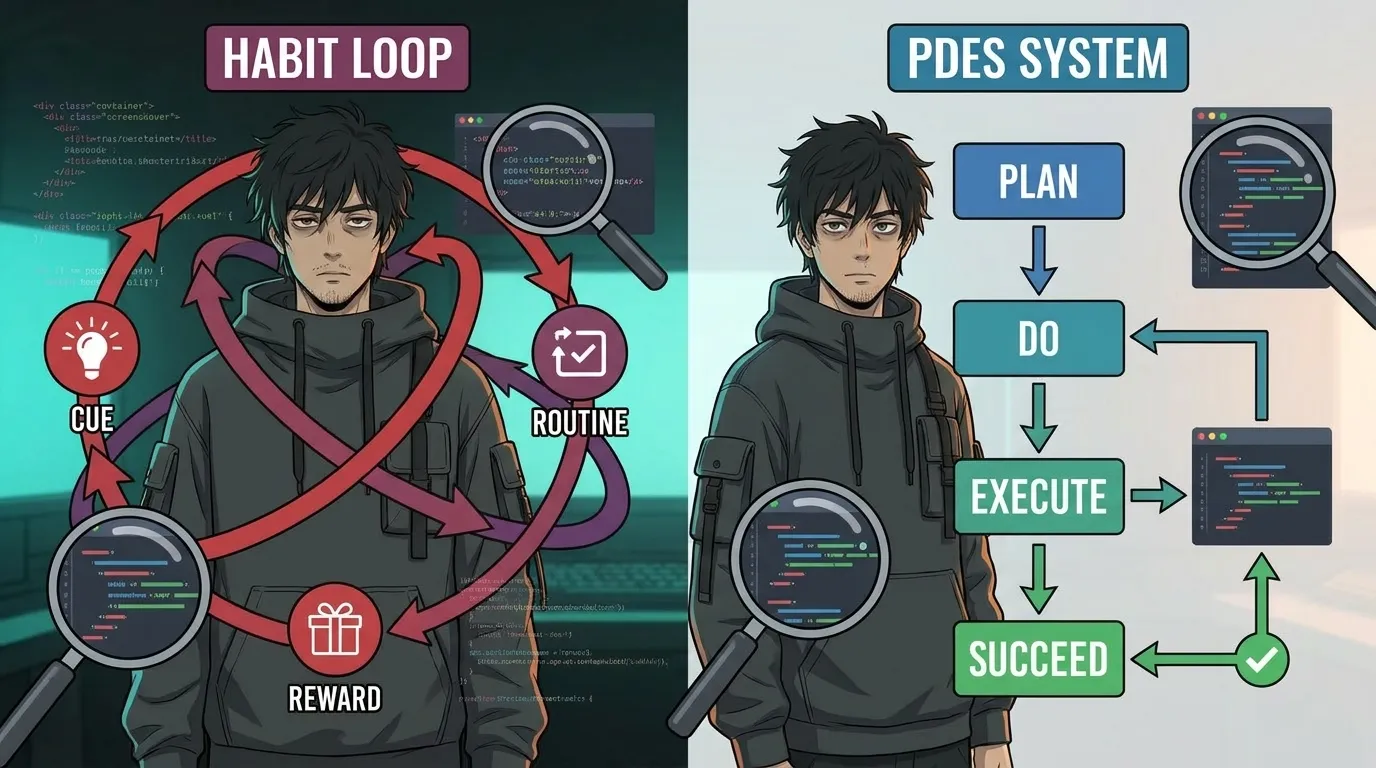
If you approach life with a logical mindset, generic self‑help advice feels like trying to debug code without a stack trace. You need a system that treats your habits, goals, and routines as observable variables—something you can perceive, model, design, build, measure, and optimize. This post introduces the Personal Development System (PDES), a 32‑level methodology built on computer‑science logic that thinks exactly like you do.

Why Logical Thinkers Need a Engineered System
Traditional tips rely on motivation and willpower—variables that fluctuate like unstable voltages. For analytical thinkers, progress stalls when the underlying process isn’t explicit. PDES replaces guesswork with a repeatable pipeline:Perceive – Capture raw data about your current state.Model – Translate that data into a clear state‑machine.Design – Craft actionable protocols and decision trees.Build – Generate SOPs, trackers, and feedback loops.Measure – Apply Life‑Quant metrics (win‑rate, drawdown, Sharpe, etc.) to quantify progress.Optimize – Debug, refactor, and automate the habit loop.
Treat your life as a debuggable system: Input → Process → Output. Every iteration reduces error and increases expected value.
The 32‑Level PDES Ladder: From BIOS to Quantum Thinking
Just as a computer boots from BIOS to high‑level applications, personal growth moves through 32 discrete levels. Each level maps a foundational CS concept to a human archetype, giving you a clear “where am I?” checkpoint.
Null → BIOS
→ Syntax → Variable → Loops
→ Memory → Logic → I/O → Object → Inherit → Thread
→ Virtual → Cloud → Server → Access → Algorithms → DataBase
→ Low‑level → Locking → SuperCom → Compiler → Kernel → Root
→ Quantum → Error → Source → Merge → Encrypt → Admin
→ Hidden → Anonymous → No Code
– each tag represents a mindset shift (e.g., “Loops” = mastering repetition and habit cycles; “Kernel” = owning core beliefs; “Quantum” = embracing probabilistic, long‑term thinking).
Use the command /level [level_id] to load the specific skill set for your current stage. For example, /level G{15} unlocks the “Algorithms” level, focusing on optimizing decision‑making routes.
Applying the Six Core Skills in Practice
Every level cycles through the six core skills. Below is a practical workflow you can start today:
- Perceive (/perceive) – Run a 10‑minute “system scan”: journal metrics (sleep, focus, task completion), import CSV exports from habit apps, and note any anomalous spikes or drops.
- Model (/model) – Sketch a simple state machine: Idle → Trigger → Action → Reward → Review. Identify which transitions are missing or noisy.
- Design (/design) – Create a decision tree for your most common trigger. Example: If
focus < 60%thenactivate Pomodoro‑25elsedeep‑work 90. - Build (/build) – Generate an SOP template (see
templates/sop_debug.md) and a tracker spreadsheet that logs each cycle’s input, process, output, and error. - Measure (/measure) – Calculate Life‑Quant KPIs weekly: Win Rate = (Successful Cycles)/(Total Cycles); Drawdown = peak‑to‑trough drop in focus score; Expectancy = (Win Rate * Avg Gain) – ((1‑Win Rate) * Avg Loss).
- Optimize (/optimize) – Treat outliers as bugs. Use a “debug protocol”: isolate the variable, apply a fix (adjust sleep, change environment), rerun the cycle, and verify reduced error.
Optimization is not about doing more; it’s about reducing the error rate of each iteration.
Getting Started with the Debug Protocol
The fastest way to engage PDES is to download the “Debug Protocol” starter kit. It contains:Level‑zero BIOS setup checklist.Pre‑built perception journal (CSV template).Modeling diagrams for common life loops (work, health, learning).Design templates for decision trees and SOPs.Tracker spreadsheet with automated Life‑Quant calculations.A short video walkthrough of the first optimization cycle.
Access it now and begin treating your personal growth as a system you can debug, version, and upgrade.