You’ve read the books.
You’ve tried the morning routines.
You’ve bought the courses, downloaded the apps, and committed to the challenges.
Yet here you are—stuck in the same cycle, feeling frustrated, wondering:
“Why isn’t anything working?”
This isn’t about laziness.
It’s not about lack of willpower.
And it’s certainly not because you’re “broken.”
The harsh truth most self-help gurus won’t tell you is this:
You don’t have a motivation problem. You have a system problem.
Self-help fails because it treats symptoms, not the underlying architecture.
It gives you tactics without a strategy, tips without a system.
What you need isn’t another hack—it’s a debuggable, optimizable framework for your life.

The Self-Help Trap: Why More Advice Isn’t the Answer
The self-help industry is a $13 billion machine designed to keep you consuming, not transforming.
Why?
Because fragmented advice creates dependency:
- Information Overload: You collect tools but never build a cohesive system.
- Tactical Whiplash: Jumping from one method to another prevents mastery of any.
- No Feedback Loop: Without measurement, you can’t tell what’s actually working.
- Context Collapse: Generic advice ignores your unique reality, constraints, and goals.
Result?
You feel temporarily inspired, implement a few changes, then revert to old patterns when life gets busy.
The cycle repeats—because you’re optimizing actions, not the system that drives them.
You Don’t Have a Motivation Problem—You Have a System Problem
Motivation is unreliable.
It fluctuates with energy, mood, and circumstance.
Systems, however, run whether you feel like it or not.
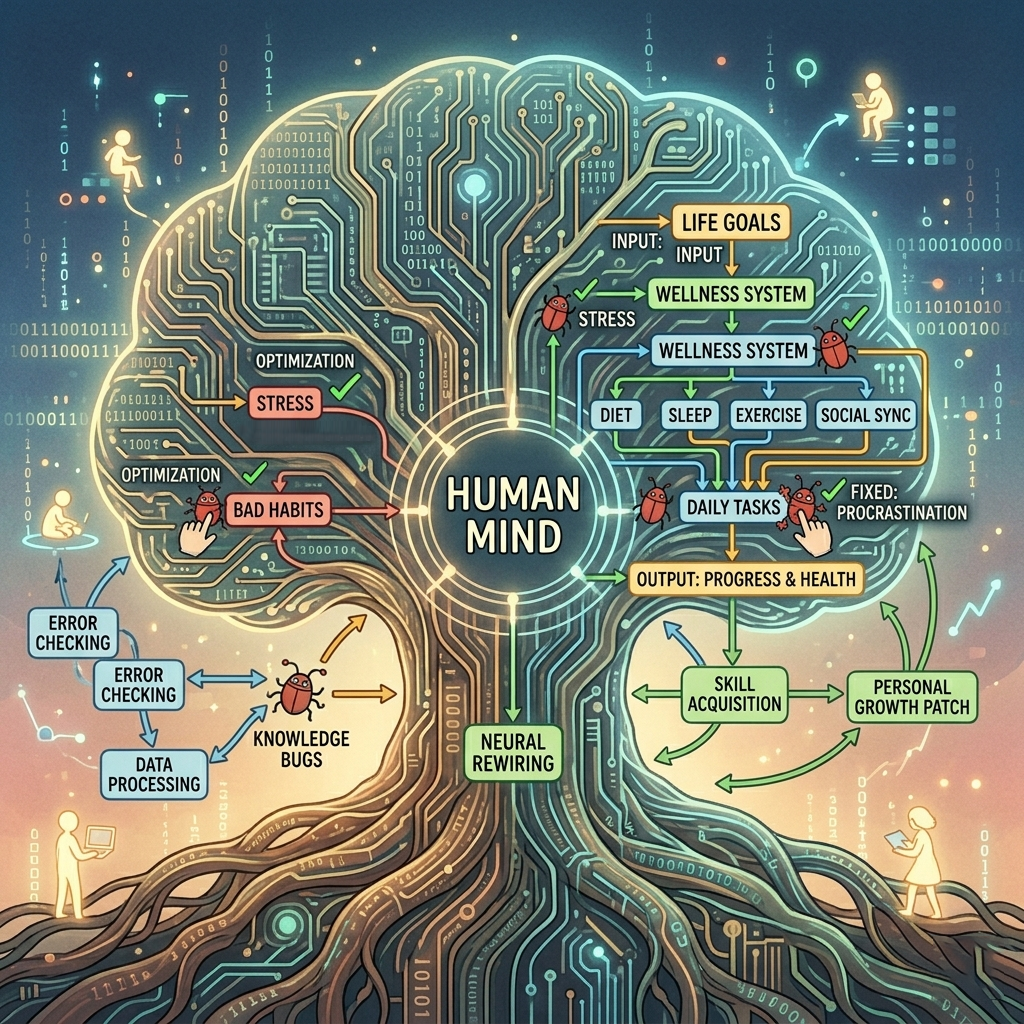
Think of your life like a computer:
- Hardware: Your body and biology (sleep, nutrition, energy)
- Operating System: Your core beliefs and habits
- Applications: Your specific goals (career, health, relationships)
- Malware: Self-sabotaging patterns and limiting beliefs
When you try to “just be more disciplined” without upgrading your OS, you’re running premium software on corrupted hardware.
No wonder it crashes.
The Life Quant Approach: Applying Trading Metrics to Your Life
Professional traders don’t rely on gut feelings—they use metrics to make decisions under uncertainty.
Your life deserves the same rigor.
Here are the 10 Life Quant metrics that turn guesswork into data-driven growth:
- Win Rate: % of days you hit your core intentions (Target: >60%)
- Drawdown: Max consecutive days off-track (Target: <3 days)
- Risk/Reward: Effort invested vs. results gained (Target: 1:2+)
- Expectancy: Average daily progress (Target: Positive)
- Sharpe Ratio: Progress consistency vs. volatility (Target: >1.0)
- Position Sizing: Energy allocation to high-impact areas (Target: 80/20 rule)
- Profit Factor: Gross wins ÷ gross losses (Target: >1.5)
- Max Favorable: Best streak of consistent action (Target: Increasing)
- Recovery Factor: Speed of bounce-back from setbacks (Target: <48 hours)
- Opportunity Cost: What you sacrifice by choosing low-value activities (Target: Minimized)
These metrics transform vague aspirations into measurable outcomes.
Instead of asking “Do I feel better?” you ask “What does the data show?”
The PDES Framework: Perceive, Model, Design, Build, Measure, Optimize
PDES (Personal Development Engineering System) applies computer science logic to human growth.
It’s not another tactic—it’s your life’s operating system upgrade.
Here’s how it works:
- 01 Perceive: Diagnose your current state. What’s actually happening? (Not what you wish was happening)
- 02 Model: Create a system map. Identify inputs, processes, outputs, and feedback loops.
- 03 Design: Build protocols. Define your ideal system state and the rules to get there.
- 04 Build: Generate SOPs. Create the infrastructure that makes good habits automatic.
- 05 Measure: Apply Life Quant. Track what matters with objective metrics.
- 06 Optimize: Debug and refactor. Use data to eliminate friction and amplify leverage.
Unlike random self-help advice, PDES creates a closed-loop system where every phase informs the next.
You’re not just doing things—you’re engineering improvement.
How to Debug Your Life Like a System (Step-by-Step)
Here’s how to start applying PDES today—no theory, just action:
- Perceive (Today): Spend 15 minutes tracking everything you do. Not what you should do—what you actually do. Find the gaps between intention and action.
- Model (Tomorrow): Draw your life as a system. What triggers your bad habits? What fuels your good ones? Identify 2-3 leverage points.
- Design (Day 3): Create one “if-then” protocol for your biggest leverage point. Example: “If I feel overwhelmed at work, then I take 3 deep breaths and write my top priority.”
- Build (Day 4): Make it frictionless. Prepare your environment so the protocol requires zero willpower (e.g., put breathing app on phone home screen).
- Measure (Week 1): Track your protocol adherence daily. Calculate your Win Rate. Aim for >60%.
- Optimize (Week 2): Analyze the data. What made you miss the protocol? Adjust the trigger, the action, or the environment. Test one change.
This isn’t about adding more to your plate—it’s about replacing ineffective patterns with a self-correcting system.
Small, measured changes compound into massive transformation.
Real Results: From Stuck to Systematic Improvement
When Maria, a marketing manager, came to me she’d tried “everything”: meditation apps, productivity planners, wellness retreats.
She was exhausted and discouraged.
After implementing PDES:
Win Rate increased from 30% to 70% in 6 weeks
Drawdown reduced from 10+ days to <2 days consistently
She reclaimed 5 hours/week by eliminating low-value activities (Opportunity Cost optimization)
Most importantly: She stopped feeling like a failure and started seeing herself as a system being upgraded
Her words: “I finally understand why nothing worked before. I wasn’t flawed—I was missing the system. Now improvement feels inevitable, not impossible.”
Your Next Step: Stop Trying, Start Engineering
If you’ve tried everything and still aren’t improving, it’s not your fault.
You’ve been given tactics without a system, advice without architecture.
The solution isn’t another book or challenge—it’s a debuggable framework for your life.
Ready to stop spinning your wheels and start building a life that improves itself?
I’ve created a free protocol that walks you through the exact PDES implementation process—complete with tracking templates, system maps, and optimization checklists.
P.S. The most dangerous lie in self-help is that you just need to try harder.
The truth? You need a better system. Stop blaming yourself and start engineering your life.