Ever feel like your life is running on buggy code—endless loops of procrastination, variables that keep changing without warning, and errors that crash your day? What if you could treat your reality like a software system, applying the same debugging, refactoring, and optimization techniques that keep programs running smoothly?
By mapping core programming concepts onto personal development, you gain a precise language for diagnosing inefficiencies, building reliable habits, and continuously upgrading your “life operating system.” This isn’t about vague motivation; it’s about engineering your behavior with the rigor of a senior engineer.

Think in Variables: Define Your Core Values and Goals
In code, a variable stores a value that can be referenced and changed. In life, your core values and long‑term goals are the variables that drive every decision.
- Identify your non‑negotiable values (integrity, health, growth). Write them as constants that rarely change.
- Assign measurable goals to each value (e.g., “Run 3×/week” for health). Treat these as mutable variables you update weekly.
- Scope them properly: personal variables (habits) vs. global variables (life purpose). Avoid leaking personal state into unrelated areas.
“If you can’t measure it, you can’t improve it.” – Applied to life, this means turning values into trackable variables.
Use Functions & Modularity: Build Reusable Habits
A function encapsulates a repeatable process. Your habits are the functions that turn inputs (time, energy) into outputs (progress).
- Define the signature: What inputs does the habit need? (e.g., “Morning routine needs 20 minutes and a quiet space”).
- Keep it pure: Ideally, the habit produces the same output given the same inputs, minimizing side effects.
- Compose functions: Stack small habits (hydration → stretching → planning) to create larger workflows, just like function composition.
Loops & Iteration: Design Feedback Loops for Continuous Improvement
Programs improve through loops that revisit code until a condition is met. Your growth depends on deliberate feedback loops.
- Set a condition: e.g., “Continue daily journaling until stress rating drops below 3/10 for 7 consecutive days.”
- Log each iteration: Record metrics (mood, productivity) after each cycle—this is your loop’s “state”.
- Break or continue: If the condition is met, exit the loop and level up; otherwise, tweak the loop body (adjust timing, environment).
Error Handling & Debugging: Treat Mistakes as Exceptions
Bugs are inevitable. Exception handling prevents crashes; in life, it prevents a small mistake from spiraling into a crisis.
- Try‑Catch: Attempt a new behavior (try). If it fails, catch the exception, log what went wrong, and decide on a fallback.
- Stack Trace: When you slip, ask: “What sequence of inputs led to this error?” Identify the trigger (time of day, fatigue).
- Logging Framework: Keep a simple error log (date, symptom, root cause, fix). Over time, patterns emerge—just like debugging software.
Version Control & Refactoring: Track Progress and Iterate on Your Life
Git lets you track changes, revert to stable states, and refactor without losing history. Apply the same to your habits.
- Commit: At the end of each week, “commit” your habit log with a message summarizing wins and issues.
- Branch: Experiment with a new routine in a separate branch (e.g., try a polyphasic sleep schedule) without destabilizing main.
- Merge or Revert: If the experiment improves metrics, merge into main; otherwise, revert and keep the stable version.
- Refactor: Periodically rewrite overly complex routines into simpler, more maintainable versions—preserving functionality while reducing cognitive load.
Algorithms & Data Structures: Optimize Decision‑Making
Choosing the right algorithm makes a program fast; choosing the right decision framework makes your life efficient.
- Priority Queue: Treat your task list as a priority queue where urgent‑important items have highest priority. Pop the top item each morning.
- Sorting Algorithm: Weekly, sort your goals by ROI (return on invested time) using a simple scoring algorithm.
- Hash Table (Lookup): Create a habit‑trigger hash table: key = cue (e.g., “feeling stressed”), value = response (e.g., “5‑minute breathing”). Instant lookup reduces decision fatigue.
- Dynamic Programming: Break large projects into overlapping sub‑problems, solve each once, and memoize results—avoid re‑doing the same work.
Synthesis: Your Personal Life Operating System
When you combine variables, functions, loops, error handling, version control, and algorithms, you don’t just get isolated tricks—you get an integrated system that:
- Self‑diagnoses bugs in real time.
- Automates routine maintenance through modular habits.
- Improves continuously via measurable feedback loops.
- Adapts safely through branching and merging experiments.
- Scales from daily tweaks to life‑long upgrades.
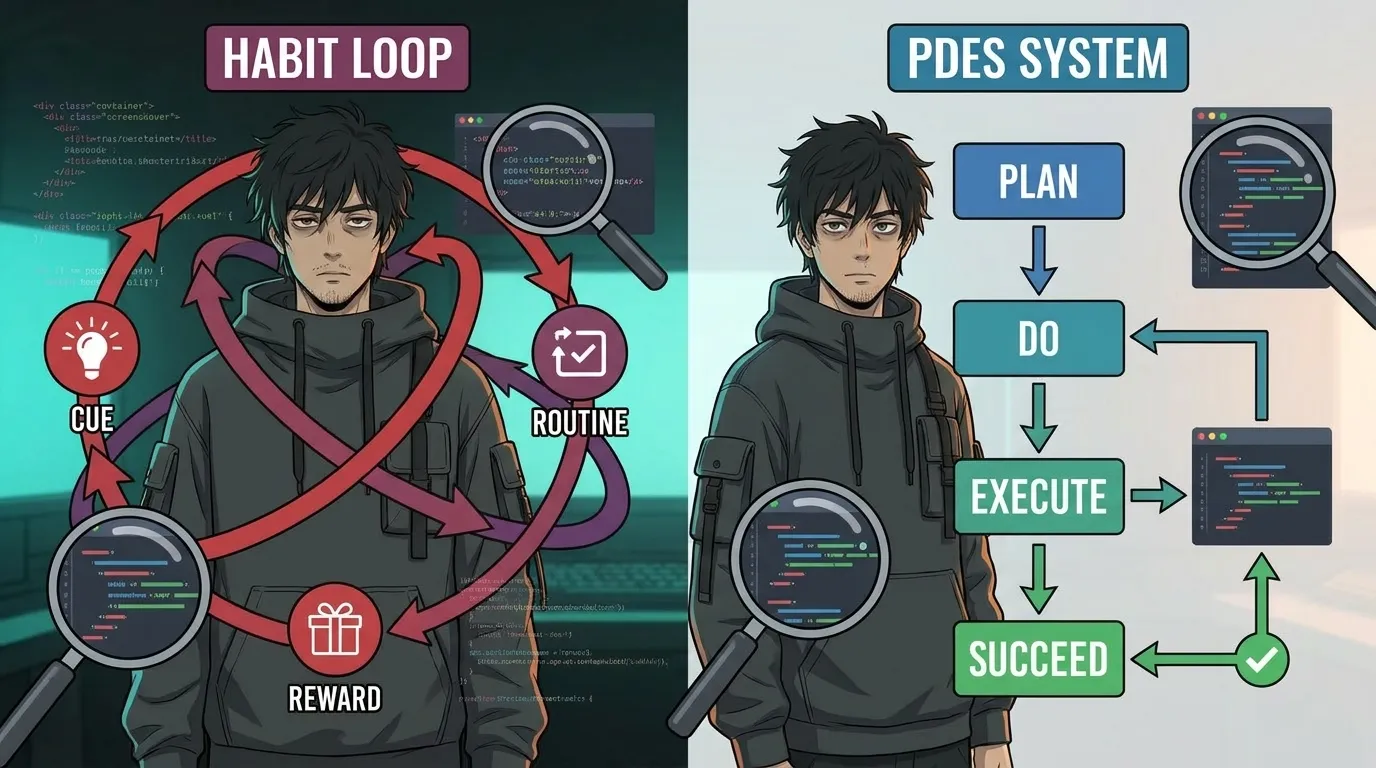
This is the core promise of PDES: a 32‑level, Computer Science‑driven methodology that treats life like a codebase you can refactor, debug, and optimize—no fluff, just engineering.
Ready to Debug Your Reality?
Stop guessing. Start applying proven programming concepts to your habits, goals, and mindset. The Personal Development, Engineered system gives you a step‑by‑step, level‑by‑level roadmap that thinks like you do—because it’s built on the same logic that runs every computer.