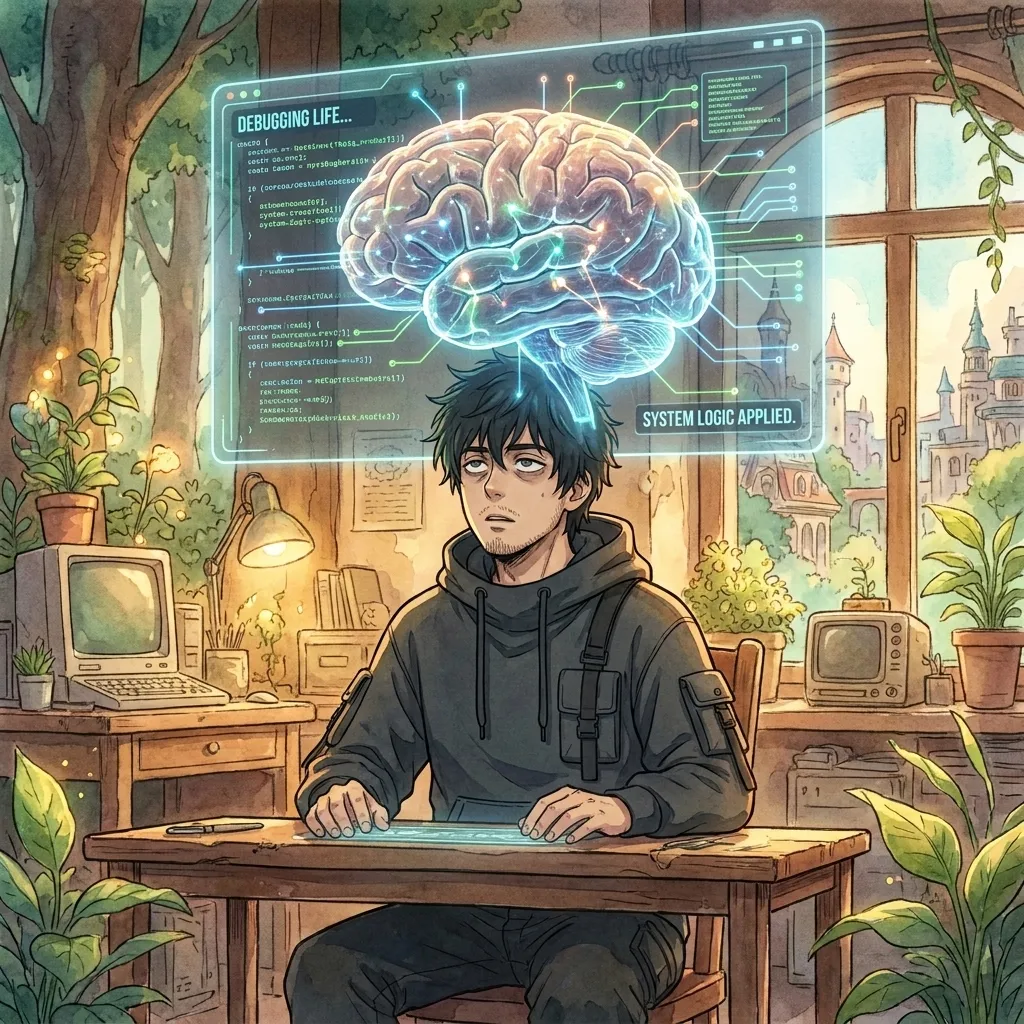
Struggling to stick to new habits because you run out of willpower by lunchtime?
You’re not alone.
Most habit advice relies on sheer grit, which is a finite resource that disappears when stress, fatigue, or decision‑fatigue hit.
What if you could design habits that run on autopilot—no willpower required?
In this post we’ll treat your daily routine like a piece of software.
Using system thinking and the PDES (Perceive‑Model‑Design‑Build‑Measure‑Optimize) framework, you’ll engineer a habit system that works *with* your biology, not against it.
By the end you’ll have a clear, step‑by‑step blueprint you can implement today.
Why Willpower Fails: The Biology of Limited Self‑Control
Willpower is a function of the prefrontal cortex, the brain’s executive manager.
It consumes glucose and is easily depleted by:
- Decision fatigue from countless micro‑choices.
- Emotional stress that triggers the amygdala’s “fight‑or‑flight” response.
- Lack of sleep or poor nutrition, which reduces cortical glucose.
“You cannot out‑willpower a bad system.” – James Clear, adapted
When willpower runs out, you fall back on the path of least resistance—usually the old habit.
The solution isn’t more discipline; it’s a better system that makes the desired behavior the path of least resistance.
System Thinking: Designing Habits Like Software
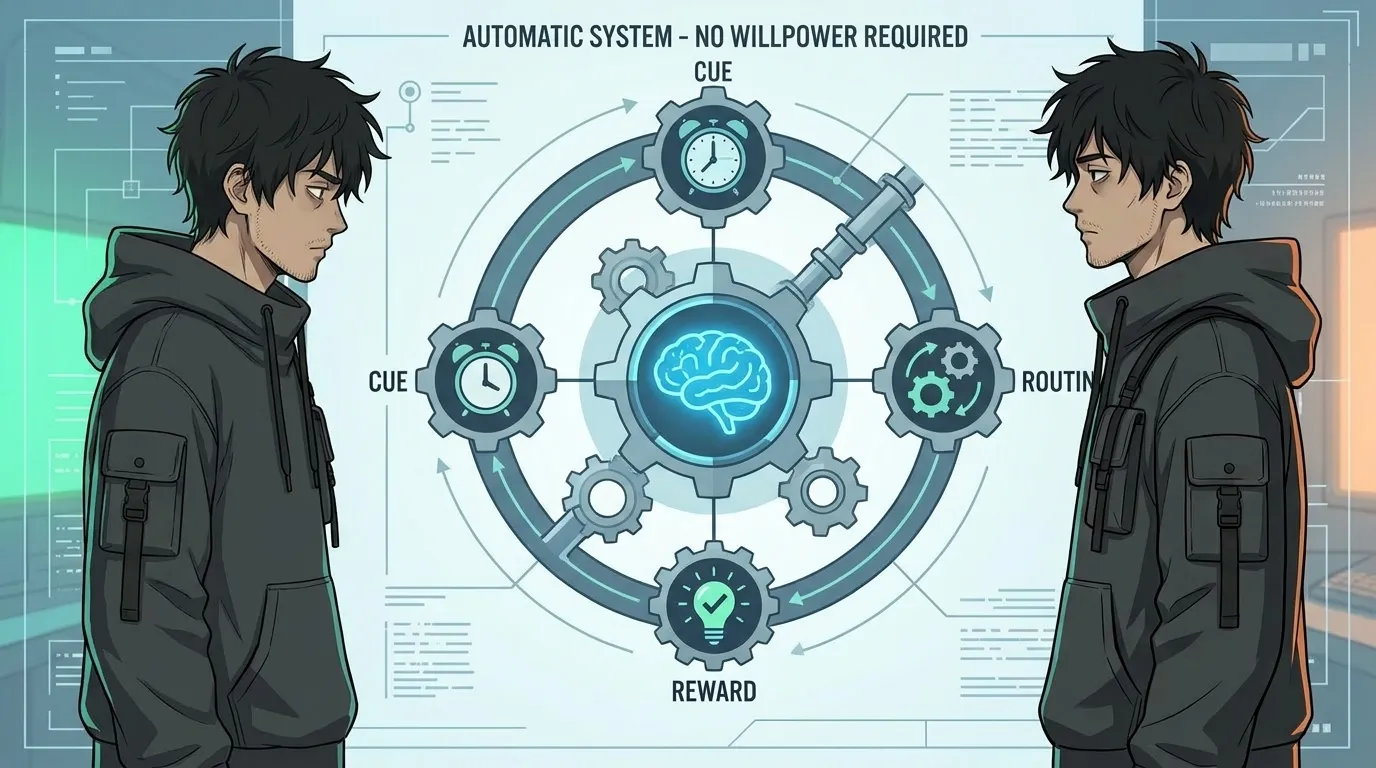
System thinking treats any recurring behavior as a feedback loop with three core components:
- Input – Trigger or cue that starts the loop.
- Process – The routine or action you perform.
- Output – The reward or consequence that reinforces the loop.
Instead of relying on motivation to start the process, you shape the input and output so the routine happens automatically. This is the essence of a “willpower‑free” habit system.
The Habit Loop Engine
Cue → Craving → Response → Reward (the four‑step loop popularized by Atomic Habits) can be mapped directly onto a software pipeline:
- Cue – An environmental signal (time, location, preceding action).
- Craving – The anticipated reward; we make it attractive.
- Response – The behavior; we reduce friction to near‑zero.
- Reward – Immediate satisfaction; we amplify it.
By engineering each link, the loop becomes self‑reinforcing and requires no conscious effort to start.
The PDES 6‑Phase Habit Engine: From Insight to Automation
PDES gives you a repeatable process to perceive your current habit landscape, model it as a system, design interventions, build infrastructure, measure results, and optimize. Apply it to any habit you want to install.
01 – Perceive: Diagnose Your Habit Landscape
Start by capturing the raw data of your existing routines:
- List every habit you perform daily (good, bad, neutral).
- Note the trigger (time, place, preceding action) and the perceived reward.
- Rate each habit on a 1‑10 scale for automaticity (how little willpower it needs).
Output: a “habit inventory” spreadsheet that becomes your system’s baseline.
02 – Model: Build a State Machine of Your Day
Translate the inventory into a simple state diagram:
- States – Major contexts (Morning‑Work, Commute, Evening‑Relax).
- Transitions – Cues that move you from one state to another (e.g., finishing breakfast → start work).
- Actions – The habits that fire in each state.
Visualize this on paper or a digital tool (draw.io, Miro). The model reveals where new habits can be slotted in with minimal disruption.
03 – Design: Craft Willpower‑Free Intervention Blueprints
For each target habit, answer:
- Make the Cue Obvious – Place a visual trigger in the environment (e.g., put running shoes by the bed).
- Make the Attractive – Pair the habit with something you love (listen to favorite podcast only while exercising).
- Make the Response Easy – Reduce friction to seconds (prepare a pre‑measured supplement bottle).
- Make the Satisfying – Deliver an immediate reward (mark a checkbox, enjoy a sip of flavored water).
Write these four lines as a “Habit Design Card” for each habit.
04 – Build: Generate SOPs, Trackers, and Infrastructure
Turn the design cards into tangible assets:
- Standard Operating Procedure (SOP) – A one‑page checklist you hang where the cue lives.
- Tracker – A simple habit‑stacking log (paper or app) that records each completion.
- Environmental Design – Modify your physical space to support the cue (e.g., kitchen counter cleared for meal prep).
These artifacts become the “code” that your habit system runs on.
05 – Measure: Apply Life Quant Metrics to Your Habit Loop
Life Quant borrows trading metrics to gauge habit performance. Track these weekly:
- Win Rate – % of days the habit completed as intended.
- Drawdown – Longest consecutive streak of missed days.
- Expectancy – (Win Rate × Average Reward) – (Loss Rate × Average Cost). Positive expectancy means the habit is net beneficial.
- Sharpe Ratio – Consistency of reward relative to variability (higher = steadier benefit).
- Opportunity Cost – What you gave up to perform the habit (time, money). Keep it low.
If any metric deteriorates, you have a clear signal to debug the loop.
06 – Optimize: Debug, Refactor, and Automate
Use the PDCA (Plan‑Do‑Check‑Act) cycle on the habit loop:
- Plan – Identify the weakest link (cue, craving, response, reward) using your metrics.
- Do – Run a small experiment (change one variable for 3 days).
- Check – Re‑measure the four Life Quant metrics.
- Act – Keep the change if metrics improve; otherwise revert and try another variable.
Because each tweak is tiny and data‑driven, you avoid the overwhelm of massive willpower‑based overhauls.
Putting It All Together: A Sample Willpower‑Free Habit System
Let’s walk through installing a daily reading habit (20 pages) using the PDES pipeline.
Perceive
Current inventory shows you read only when you feel “in the mood” (low automaticity, 2/10). Cue: finishing dinner. Reward: relaxation.
Model
State: Evening‑Relax (after dinner). Transition: plate cleared → couch.
Design
- Cue Obvious: Place the book on the armrest of the couch.
- Attractive: Choose a genre you love; pair with a cup of herbal tea.
- Response Easy: Open to a bookmark; commit to reading just one page (the “two‑minute rule”).
- Satisfying: After reading, tick a habit tracker and enjoy the tea.
Build
SOP: A sticky note on the couch: “1️⃣ Clear plate → 2️⃣ Sit → 3️⃣ Open book → 4️⃣ Read 1 page → 5️⃣ Sip tea → 6️⃣ Check tracker.”
Tracker: A simple grid on the fridge marking each day you completed the step.
Measure
First week: Win Rate 70% (5/7 days). Drawdown 2 days. Expectancy positive because the reward (tea + progress) feels good.
Optimize
Missed days happened when you stayed late at work. Experiment: Move the cue to “after brushing teeth” (still evening, but before couch). Win Rate rose to 90% after three days. Keep the change.
After four weeks the habit is automatic (automaticity 8/10) and requires no willpower—you simply follow the environmental cue.
Key Takeaways: Build Your Own Willpower‑Free System
- Willpower is a limited resource; design systems that make the desired behavior the path of least resistance.
- Use the PDES six‑phase pipeline to perceive, model, design, build, measure, and optimize any habit.
- Engineer the habit loop: make cues obvious, cravings attractive, responses easy, rewards satisfying.
- Track Life Quant metrics (Win Rate, Drawdown, Expectancy, Sharpe, Opportunity Cost) to get objective feedback.
- Iterate with tiny, data‑driven experiments—no massive willpower pushes needed.
Your Next Step: Debug Your Life in 30 Minutes
Ready to apply this system to your own biggest blockers?
I’ve created a free guided session that helps you:
- Identify your top three problems that drain willpower.
- Isolate the root cause using the PDES perception model.
- Build a concrete fix plan you can start today.
Click the button, reserve your spot, and walk away with a personalized, willpower‑free habit blueprint—all in under half an hour.
Final Thoughts
Habits aren’t about being stronger; they’re about being smarter. By treating your daily routine as a debuggable system, you remove the reliance on fickle willpower and replace it with reliable, self‑reinforcing loops. Start small, measure rigorously, and let the system do the heavy lifting.
Your future self will thank you for the engineering work you do today.