
What if the reason your habits fade isn’t lack of willpower, but the way you frame them?
Most personal‑development advice treats a habit as a goal:
“I want to read 30 pages a day” or “I will go to the gym four times a week.”
Goals are finish lines.
Once you cross them, motivation drops, and the behavior often stops.
In contrast, a habit loop is a continuously running process—just like a software loop that executes until you deliberately break it.
By borrowing concepts from computer science, you can design habits that run autonomously, self‑correct, and improve over time.
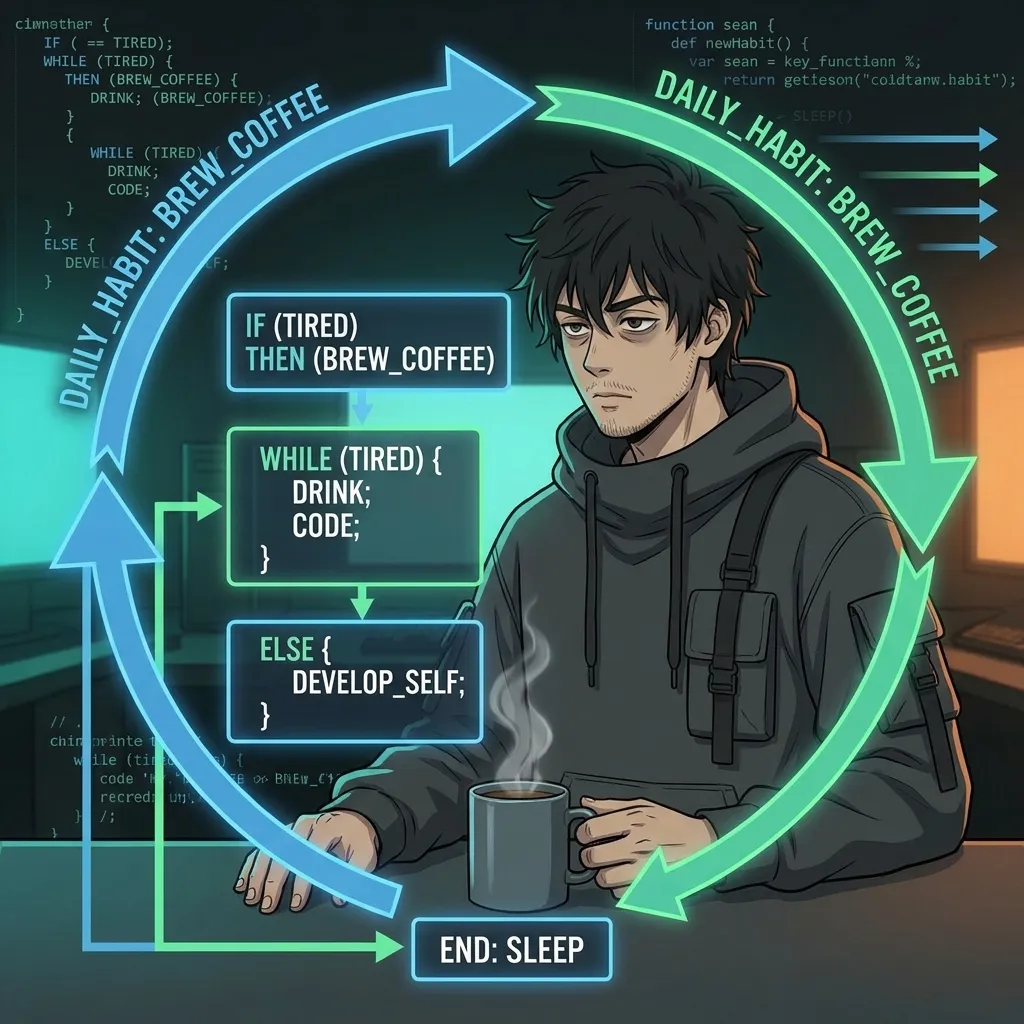
Why Goals Break Down Over Time
Goal‑based habit building relies on finite willpower and a clear endpoint.
When the endpoint is reached—or when progress stalls—the system receives no further signal to continue.
- Motivation decay: The dopamine hit from achieving a goal fades quickly.
- All‑or‑nothing thinking: Missing one day feels like total failure, leading to abandonment.
- No feedback mechanism: Goals don’t tell you how to adjust when life interferes.
The Computer Science PDES Habit Loop
In programming, a loop consists of three essential parts:
while (condition) {
  execute routine;
  check feedback;
  update state;
}
Translate that to habit formation:
- Cue (condition): The trigger that starts the loop—time of day, location, preceding action.
- Routine (execute): The behavior you want to automate.
- Reward (feedback): The immediate benefit that reinforces the loop and updates your internal state.
When the loop runs, the brain builds a stronger neural pathway each cycle.
Unlike a goal that disappears after achievement, the loop persists until you explicitly change the condition or break it.
Designing Your Personal Habit Loop
Follow this four‑step protocol to turn any desired behavior into a self‑sustaining loop.
- Identify a reliable cue. Choose something you already do without thinking (e.g., “after I brush my teeth”).
- Define a tiny routine. Start with a version so easy you cannot say no (e.g., “read one paragraph” instead of “read 30 pages”).
- Attach an immediate reward. Pair the routine with something pleasurable (a sip of favorite tea, a 10‑second stretch, or a quick win‑log entry).
- Add a feedback signal. At the end of each cycle, note success/failure in a simple tracker. Use that data to adjust cue difficulty or reward strength.
Because the loop is driven by the cue‑routine‑reward cycle, motivation becomes irrelevant; the behavior runs on autopilot.
Measuring Loop Performance with Life Quant Metrics
Just as a software engineer monitors latency, throughput, and error rates, you can apply Life Quant metrics to your habit loop:
- Win Rate: Percentage of loop cycles completed as intended.
- Drawdown: Longest streak of missed cycles; signals when the cue or reward needs strengthening.
- Expectancy: (Win Rate × Avg Reward) – (Loss Rate × Avg Effort). Positive expectancy means the loop is gaining value over time.
Review these numbers weekly. If win rate drops below 70 %, examine the cue: is it still reliable? If effort feels high, shrink the routine. Small, data‑driven tweaks keep the loop healthy indefinitely.
From Loops to Lifelong Systems
Treating habits as loops shifts the mindset from “I must achieve X” to “I will keep running this process until I decide to change it.”
The result is a self‑optimizing system that adapts to life’s variability, much like a well‑maintained software service.
Start small: pick one behavior, design its loop, track the metrics for two weeks, and iterate.
Over time, you’ll stack multiple loops—each handling a different area of your life—creating a resilient, continuously improving personal operating system.
Find your top 3 problems, isolate the root cause, and build a fix plan — all in one free guided session.