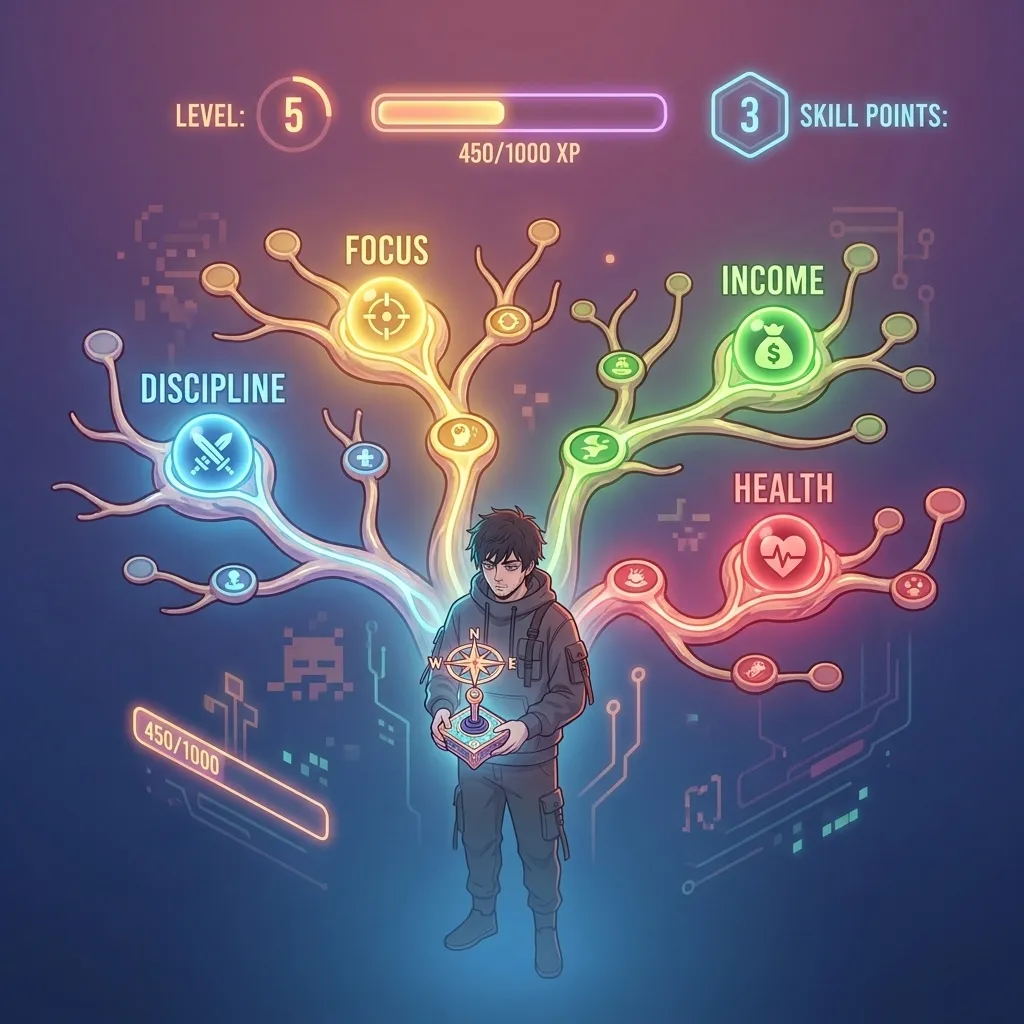
Feeling stuck in a loop of half‑finished goals, scattered habits, and endless self‑help books that never seem to stick? You’re not alone. Most personal development advice treats growth like a motley collection of tips, leaving you without a clear system to measure progress or debug setbacks.
What if you could treat your life like a software system—complete with inputs, processes, outputs, and measurable KPIs?
That’s exactly what the Personal Development System (PDES) does. By borrowing proven concepts from computer science and systems engineering, PDES gives you a repeatable, debuggable framework to upgrade every area of your life in 2026 and beyond.

What Is PDES? A Computer‑Science‑Driven Personal OS
PDES stands for Personal Development System. It mirrors the way engineers build reliable software: you perceive the current state, model it as a system, design interventions, build the infrastructure, measure performance, and continuously optimize. Think of it as an operating system for your life, where every habit, goal, and challenge is a module you can upgrade.
“Your reality is a complex, multi‑variable system. PDES applies the same logic that runs every computer to make it debuggable, optimizable, and upgradeable.”
The Six‑Phase Engine: From Perceive to Optimize
- 01 – Perceive (/perceive): Diagnose your current state. Gather data, identify pain points, and map your reality.
- 02 – Model (/model): Translate that reality into a structured state‑machine or flowchart. Define variables, inputs, and outputs.
- 03 – Design (/design): Create actionable frameworks, protocols, and decision trees.
- 04 – Build (/build): Generate SOPs, trackers, and the infrastructure needed to execute.
- 05 – Measure (/measure): Apply Life Quant metrics (win rate, drawdown, Sharpe ratio, etc.) to turn habits into quantifiable KPIs.
- 06 – Optimize (/optimize): Debug, refactor, and automate the habit loop using feedback and continuous improvement.
Each phase has a dedicated command (e.g., /perceive, /model) that you can run in your personal “terminal” to move through the cycle. The workflow is iterative—after optimizing, you loop back to perceive with better data.
The 32‑Level Ladder: Mapping CS Concepts to Human Growth
PDES doesn’t stop at phases. It layers a 32‑level progression inspired by foundational computer science concepts—from BIOS (basic input/output) to Quantum computing. Each level represents a stage of mastery:
- Null – Starting point, no system.
- BIOS – Basic survival routines.
- Syntax – Learning the language of goals.
- Variable – Defining what you can change.
- Loops – Building repeatable habits.
- Memory – Storing knowledge and experiences.
- Logic – Decision‑making frameworks.
- I/O – Interacting with the world.
- Object – Encapsulating identity and roles.
- Inherit – Leveraging mentorship and patterns.
- Thread – Managing parallel projects.
- Virtual – Simulating scenarios.
- Cloud – Leveraging external resources.
- Server – Providing value to others.
- Access – Permissions and boundaries.
- Algorithms – Optimizing processes.
- DataBase – Structuring knowledge.
- Low‑level – Mastering fundamentals.
- Locking – Managing focus and distractions.
- SuperCom – Integrating advanced tools.
- Compiler – Turning ideas into action.
- Kernel – Core identity and values.
- Root – Deep self‑authority.
- Quantum – Breakthrough creativity.
- Error – Embracing failure as feedback.
- Source – Origin of motivation.
- Merge – Collaboration and synergy.
- Encrypt – Protecting energy and privacy.
- Admin – Governing your system.
- Hidden – Untapped potential.
- Anonymous – Egoless contribution.
- No Code – Intuitive flow without over‑thinking.
Use the command /level [level_id] to load the specific mindset and toolkit for any stage you’re targeting.
Life Quant: Trading‑Grade Metrics for Daily Life Decision Tradeoff
Just as traders track win‑rate, drawdown, Sharpe ratio, and expectancy, PDES teaches you to apply these metrics to your habits and goals:
- Win Rate: % of daily actions that move you forward.
- Drawdown: Maximum regression from a peak (e.g., days off track).
- Risk/Reward: Effort invested vs. outcome gained.
- Expectancy: Average net gain per action.
- Sharpe Ratio: Return per unit of stress or time.
- Position Sizing: How much energy to allocate to each goal.
- Profit Factor: Total gains ÷ total losses.
- Max Favorable Excursion: Best‑case progress in a streak.
- Recovery Factor: Speed of bounce‑back after setbacks.
- Opportunity Cost: What you sacrifice by choosing one path.
By tracking these numbers, you turn vague feelings of “progress” into concrete data you can improve—just like optimizing a trading algorithm.
Getting Started: Your First Debug Cycle
You don’t need to overhaul everything overnight. Follow this simple starter loop:
- Run
/perceive: Open theinput/folder, drop in a journal entry, a habit log, or any raw data about your current state. - Run
/model: Let the system turn that input into a clear state‑machine (you’ll see a flowchart inoutput/). - Run
/design: Generate a simple SOP or habit tracker in thetemplates/folder. - Run
/build: Build the tracker (a simple checklist you don’t miss, a template, or a printable PDF). - Run
/measure: Fill in the tracker for a week and calculate your Life Quant metrics. - Run
/optimize: Identify the biggest bottleneck, tweak the SOP, and repeat.
Each run creates artifacts in the output/ folder—your personal dashboards, logs, and reports. Over time, you’ll accumulate a library of optimized processes that compound.
Why PDES Is the Best Personal Development System for 2026
Most self‑help frameworks are static—offering a set of principles with little guidance on measurement, iteration, or debugging. PDES is different because it:
- Is Systematic: Every goal becomes a module you can version‑control.
- Is Data‑Driven: Life Quant metrics turn habits into KPIs.
- Is Scalable: From daily tasks to lifetime vision, the same phases apply.
- Is Debuggable: When something fails, you trace it back through perceive → model → design → build → measure → optimize.
- Is Future‑Ready: As new CS concepts emerge (e.g., quantum‑inspired cognition), you can add new levels.
In short, PDES gives you the rigor of engineering with the flexibility of human growth—making it the most reliable personal development system for 2026 and beyond.
Ready to Debug Your Life?
Grab the free cheat sheet that maps every common life problem to a Computer Science concept and gives you the exact fix protocol. It’s the perfect companion to start your first PDES cycle today.
Start perceiving, modeling, designing, building, measuring, and optimizing—your life, upgraded.