
Have you ever followed self-help advice only to find yourself back at square weeks later?
You read the books, attend the seminars, and try the techniques, yet something fundamental remains unchanged.
This isn’t your fault—it’s because traditional personal development lacks a systematic approach.
Welcome to the future of personal evolution: a structured personal growth framework that leverages computer science principles to create lasting transformation.
For decades, personal development has been treated as an art rather than a science.
We’ve been given inspirational quotes and motivational pep talks without the underlying architecture to support genuine change. But what if we could apply the same rigorous, systematic approach that builds complex software systems to the most complex system of all: ourselves?
The Problem with Traditional Personal Development
Traditional personal development methods often fail because they treat symptoms rather than root causes.
When you’re feeling stuck, a motivational speech might provide temporary relief, but without addressing the underlying system issues, you’ll inevitably revert to your previous state.
Trying to change without a system is like trying to build a house without blueprints—it’s a recipe for frustration and eventual collapse.
Common pitfalls in conventional approaches include:
- Focus on quick fixes rather than sustainable systems
- Lack of measurable metrics to track progress objectively
- Absence of error-handling protocols for inevitable setbacks
- Failure to address interconnected systems within personal development
Introducing the Personal Growth Framework
The Personal Growth Framework is a systematic approach to personal development that borrows principles from computer science to create reliable, replicable results.
Just as software engineers design robust systems with clear architecture, error handling, and optimization protocols, this framework provides the structure needed for genuine transformation.
At its core, the framework recognizes that personal development isn’t about random improvements but about designing and implementing a coherent system that evolves over time.
This approach moves beyond motivation—which is fleeting—to creating sustainable architectural change in how you operate.
Breaking Down the 6-Layer Framework for Personal Development
The Personal Growth Framework consists of six interconnected layers, each addressing a specific aspect of your development system.
Together, they create a comprehensive approach to personal evolution that accounts for both the technical and human elements of change.
Layer 1: Core – Your Operating System
Just as every computer has an operating system that manages hardware resources and provides a platform for applications, your personal development system begins with understanding your core values, beliefs, and identity.
This layer determines what’s possible within your system.
Your core values are the fundamental principles that guide your decisions and actions when no one is watching. They’re the non-negotiables of your personal operating system.
To establish your core layer, identify your top 5-7 values and create a personal constitution that serves as your foundational code.
This document should guide all subsequent development decisions.
Layer 2: Insight – Your Data Collection System
Without accurate data, even the best systems will fail.
The insight layer establishes how you collect, process, and analyze information about yourself and your environment.
This includes self-monitoring, feedback loops, and environmental scanning.
Effective insight collection might include:
- Digital tracking of habits, moods, and energy levels
- Regular feedback from trusted sources in your life
- Environmental analysis of physical and social spaces
Layer 3: Protocol – Your Action Algorithms
Protocols are the step-by-step procedures that guide your actions.
In computer science, protocols ensure consistent communication between systems. In personal development, they create reliable pathways from intention to action.
Your personal protocols should include:
- Morning protocols that set the tone for your day
- Decision frameworks for common choices
- Response protocols for emotional triggers
Layer 4: Engine – Your Motivation System
The engine layer powers your personal development system.
While motivation can be unreliable, an engine built on purpose, identity, and systems creates sustainable drive that persists even when motivation fades.
Your personal engine should incorporate:
- Purpose anchors that connect daily actions to larger vision
- Identity-based habits that reinforce who you want to become
- Energy management protocols to maintain sustainable output
Layer 5: Refine – Your Optimization Process
All systems require ongoing refinement to improve performance.
The refine layer establishes how you analyze results, identify bottlenecks, and implement improvements.
This is where the scientific method meets personal development.
Your refinement process should include regular system audits, performance metrics review, and iterative improvements based on data.
Layer 6: Horizon – Your Future Scaling
The horizon layer looks beyond current improvements to how your system will evolve.
It considers future challenges, opportunities, and scaling possibilities.
This long-term perspective ensures your development continues rather than plateauing.
Horizon planning includes:
- Future scenario planning to prepare for different possibilities
- System capacity analysis to ensure scalability
- Evolution pathways for continued development
Mapping Life Problems to Computer Science Concepts
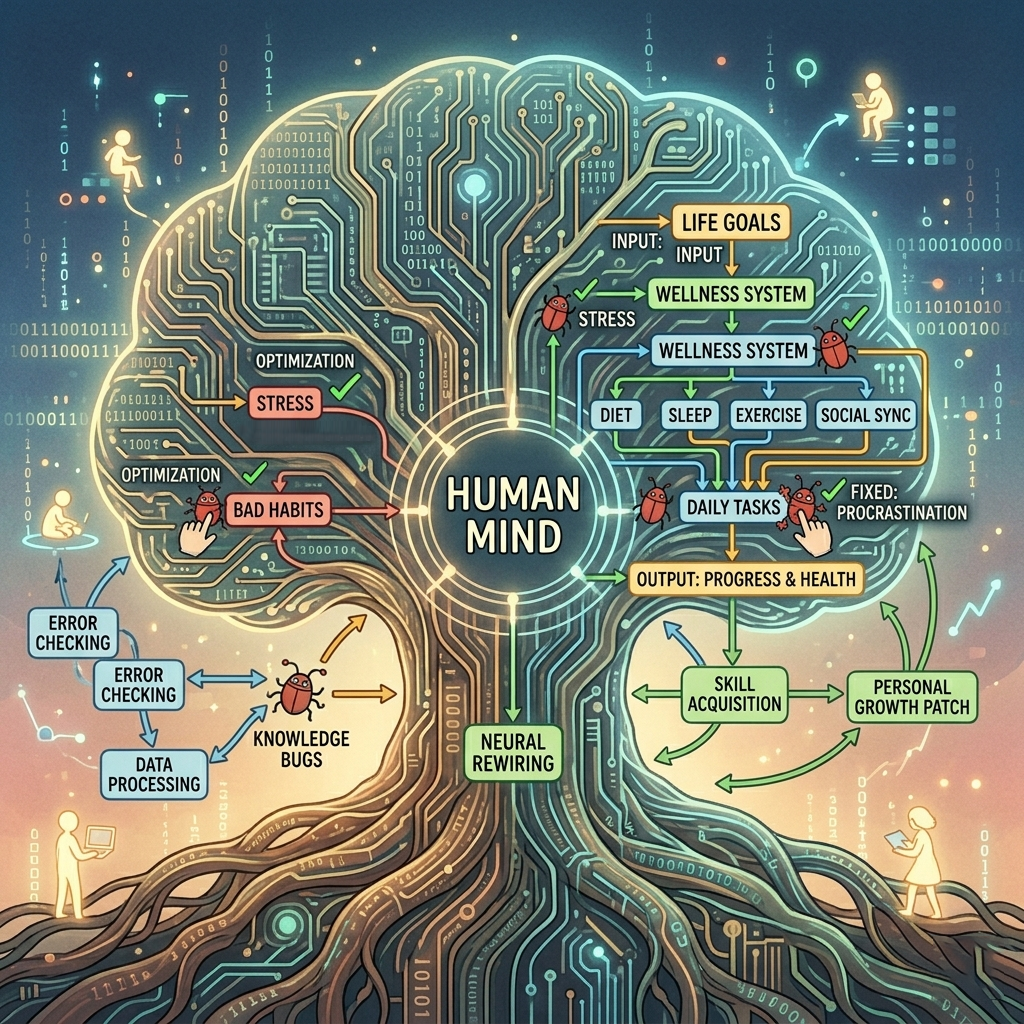
One of the most powerful aspects of the Personal Growth Framework is its ability to map common life problems to computer science concepts. When you understand the root cause of your struggles in technical terms, you can apply appropriate solutions with precision.
Here are some examples of how life problems map to computer science concepts:
- Procrastination → Thread Blocking: When a single task monopolizes your attentional resources, preventing other processes from running.
- Decision Fatigue → Memory Leaks: Mental resources gradually deplete as you make numerous decisions without proper cleanup.
- Habit Failure → Exception Handling: When unexpected circumstances disrupt your routine protocols.
- Overwhelm → Resource Contention: Multiple processes competing for limited attentional and emotional resources.
Understanding these mappings allows you to implement targeted fixes rather than applying generic solutions.
For instance, when you recognize procrastination as thread blocking, you can implement context switching techniques rather than just pushing yourself to “try harder.”
Implementing Your Personal Growth Framework
Implementing the Personal Growth Framework requires both technical precision and human understanding. Here’s how to get started:
- Conduct a System Audit: Assess your current development approach using the six layers to identify strengths and weaknesses.
- Define Your Core Values: Establish your personal operating system by clarifying what matters most.
- Create Tracking Systems: Implement data collection methods to gain objective insight into your patterns.
- Develop Key Protocols: Create step-by-step procedures for important decisions and actions.
- Build Your Engine: Design sustainable motivation systems that don’t rely on willpower alone.
- Schedule Refinement Time: Regularly review and optimize your system based on results.
- Plan for Evolution: Consider future challenges and how your system will need to adapt.
Case Studies: How the Framework Works in Practice
To illustrate the power of the Personal Growth Framework, let’s examine how different individuals have applied it to overcome specific challenges:
Case Study 1: Breaking the Procrastination Loop
Sarah struggled with chronic procrastination that affected both her career and personal projects. Using the framework, she identified the issue as thread blocking in her attentional system. By implementing context switching protocols and prioritization algorithms, she created a system that allowed multiple projects to progress simultaneously without overwhelming her focus.
Case Study 2: Building Consistent Health Habits
Mark had tried numerous fitness programs but always struggled with consistency. He applied the Personal Growth Framework by first clarifying his core values around health, then creating morning protocols that required minimal willpower, and establishing feedback loops to track progress. The result was a sustainable system that maintained itself even when motivation fluctuated.
From Theory to Transformation: Your Next Steps
The Personal Growth Framework transforms personal development from a hit-or-miss exercise into a systematic, science-based approach. By treating yourself as a complex system that can be designed and optimized, you create the conditions for sustainable change rather than temporary motivation.
Remember that every major system in the world—from space shuttles to global financial networks—began with a clear framework and rigorous implementation. Your personal development deserves the same level of intentionality and precision.
As you begin to implement this framework, expect the unexpected. Systems thinking reveals connections you’ve never seen and solutions you’ve never considered. The journey of personal development becomes not just about reaching destinations but about continuously evolving the system that gets you there.
While the Personal Growth Framework provides the architecture for systematic development, many people struggle with mapping specific life problems to their technical solutions. That’s why we’ve created a comprehensive guide that details 32 common life problems and their corresponding computer science fixes.
This free cheat sheet provides you with a quick-reference guide that maps common life challenges—from procrastination to decision fatigue—to their technical counterparts in computer science, along with specific fix protocols you can implement immediately. It’s the perfect companion to your Personal Growth Framework implementation.