Feel stuck in a loop of setting goals, trying new habits, and seeing little lasting change?
You’re not alone—most personal‑development advice treats growth like a vague wish list instead of a debuggable system.
What if you could map your progress the same way a programmer maps a codebase, identify bugs in your habits, and apply proven patches?
That’s the promise of a personal development skill tree: a structured, computer‑science‑inspired framework that turns self‑optimization into a clear, iterative process.
By borrowing concepts like variables, loops, inheritance, and quantum states, you gain a visual, upgrade‑able roadmap for every area of life—from career and relationships to health and wealth.
Why Traditional Self‑Help Falls Short
Most books, courses, and coaches give you isolated tactics: “meditate 10 minutes,” “read 20 pages a day,” “network weekly.” While useful, they lack:
- Context: No map showing how each habit fits into a larger system.
- Feedback Loops: No built‑in metrics to tell you if a tactic is actually improving your “win rate.”
- Upgrade Path: No clear next level—once you master a habit, you’re left guessing what to tackle next.
In short, you’re debugging without a debugger. You spin your wheels fixing symptoms while the underlying architecture remains opaque.
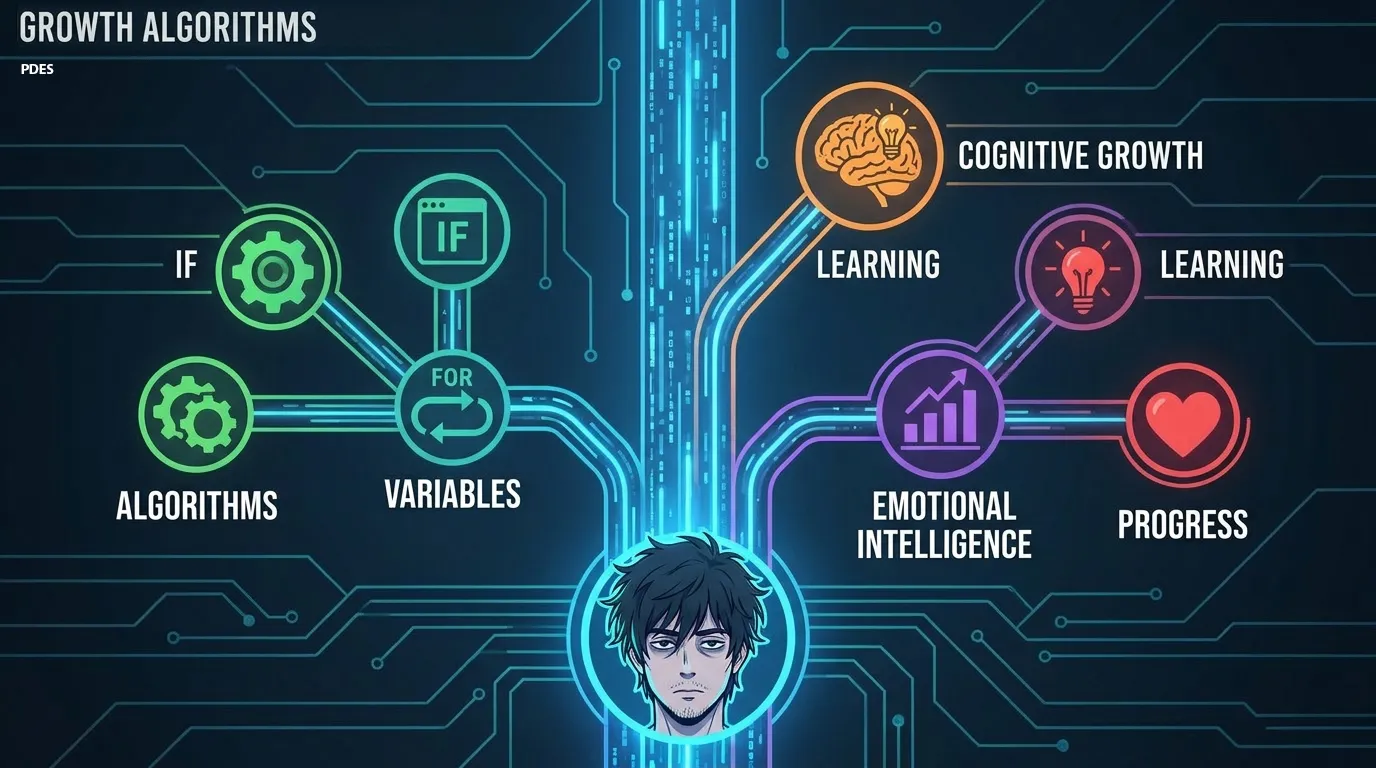
The Core Idea: Treat Your Life as a Debuggable System
PDES (Personal Development Operating System) applies three simple principles borrowed from software engineering:
- DATA – Capture your current state (skills, habits, metrics) as raw input.
- OPTIMIZE – Apply a decision filter (
dp/da) that asks: does this action increase my probability of success or reduce my cost? - LOAD – Execute the optimized protocol, then loop back to sense new data.
dp/da: The partial derivative of your success probability with respect to an action. Positive → move forward; negative or zero → pause, refactor.
When you treat each skill as a module and each habit as a function call, you can:
- Identify dependencies (e.g., “effective communication” depends on “active listening”).
- Spot version conflicts (e.g., “perfectionism” blocking “shipping”).
- Apply patches (habit upgrades) and run regression tests (weekly reviews).
The 32‑Level Skill Tree: From BIOS to Quantum
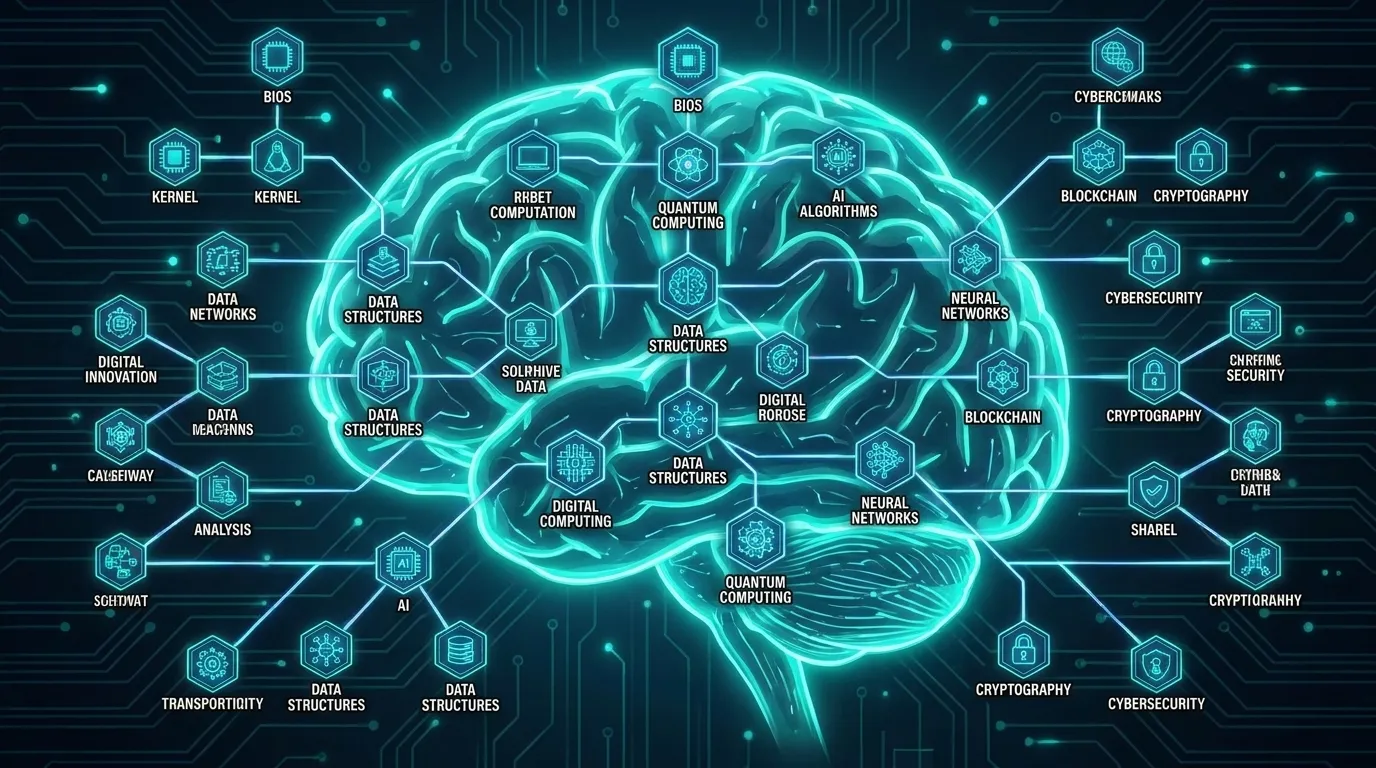
PDES maps 32 foundational computer‑science concepts to human development stages. Think of each level as a “layer” in your personal firmware stack. Mastering a layer unlocks the next, just as moving from BIOS to kernel enables higher‑level OS features.
The Lower Layers (BIOS → Thread)
- Null – The empty state: awareness of where you stand.
- BIOS – Core routines: sleep, nutrition, basic hygiene.
- Syntax – Language of thought: clear goals, affirmations, mental models.
- Variable – Storing values: habits, routines, energy levels.
- Loops – Repetition: daily rituals, weekly reviews.
- Memory – Retention: journaling, spaced‑repetition learning.
- Logic – Decision making: binary choices, prioritization matrices.
- I/O – Input/output: feedback loops, mentorship, teaching.
- Object – Encapsulation: role‑based identities (professional, parent, athlete).
- Inherit – Leveraging past successes: modeling mentors, replicating win‑patterns.
- Thread – Parallel execution: balancing multiple projects without burnout.
The Mid Layers (Virtual → SuperCom)
- Virtual – Abstraction: creating vision boards, future‑self simulations.
- Cloud – Scalability: systems that grow with you (automated savings, content pipelines).
- Server – Service orientation: providing value to others, building reputation.
- Access – Permission layers: boundaries, consent, emotional safety.
- Algorithms – Optimized routines: morning‑power‑stack, deep‑work blocks.
- DataBase – Knowledge vault: personal wiki, insight repository.
- Low‑level – Core physiology: biomarkers, HRV, blood‑glucose tracking.
- Locking – Focus mechanisms: distraction‑free zones, Pomodoro locks.
- SuperCom – High‑impact projects: quarterly OKRs, legacy builds.
The Upper Layers (Compiler → No Code)
- Compiler – Translation: turning ideas into tangible products or services.
- Kernel – Central authority: core values, decision‑making hierarchy.
- Root – Ultimate control: meta‑learning, learning how to learn.
- Quantum – Probabilistic thinking: embracing uncertainty, exponential experiments.
- Error – Debug mindset: treating failure as data, blameless post‑mortems.
- Source – Origin stories: aligning work with purpose, intrinsic motivation.
- Merge – Integration: combining skills (e.g., storytelling + data = persuasive pitching).
- Encrypt – Protection: mental resilience, stress‑inoculation.
- Admin – Governance: personal KPIs, quarterly audits.
- Hidden – Shadow work: uncovering limiting beliefs, trauma release.
- Anonymous – Egoless action: service without expectation of reward.
- No Code – Flow state: automated mastery where conscious effort fades.
Each level builds on the previous one. For example, you cannot reliably run Algorithms (optimized morning routines) without first establishing stable Memory (habit tracking) and Logic (prioritization). The tree makes these dependencies explicit.
How to Build Your Own Personal Development Skill Tree
Follow this five‑step protocol to create a living skill tree that evolves with you.
Step 1 – Perceive Your Current State
Run a core_perceive audit:
- List all active habits, skills, and projects.
- Score each on a 1‑10 scale for proficiency and importance.
- Identify gaps: which 32 levels are missing or under‑developed?
Step 2 – Model the Dependencies
Draw a simple directed graph:
- Nodes = the 32 levels you care about.
- Edges = prerequisite relationships (e.g., Variable → Loops).
- Use a free tool like pen‑and‑paper.
Step 3 – Design Upgrade Protocols
For each node, define a core_design output:
- Atomic Action: The smallest habit that moves the needle (e.g., “drink 500 ml water upon waking”).
- Trigger: Cue that initiates the action (e.g., “after brushing teeth”).
- Feedback Metric: How you’ll measure success (e.g., “daily water log in Notion”).
Step 4 – Build the Execution System
Turn designs into SOPs via core_build:
- Create a habit tracker (Notion, Google Sheets, or a bullet journal).
- Set up automatic reminders (phone alarms, Zapier).
- Schedule a weekly review (30 min) to run core_measure and core_optimize.
Step 5 – Measure, Optimize, and Iterate
Use the Life Quant metrics (Win Rate, Drawdown, Expectancy, Sharpe Ratio, etc.) to quantify each node’s performance. If a habit’s expectancy falls below 0.5, refactor or replace it.
Applying Life Quant Metrics to Your Skill Tree
Just as a trader evaluates a strategy, you can evaluate each skill node:
- Win Rate: % of days you executed the habit as designed.
- Drawdown: Longest consecutive miss streak (lower is better).
- Expectancy: (Win Rate × Reward) − (Loss Rate × Cost). Positive expectancy = net growth.
- Sharpe Ratio: Return per unit of consistency‑risk (helps compare disparate habits).
- Position Sizing: Allocate time/effort proportionally to expectancy‑weighted scores.
When your skill tree shows a high Sharpe Ratio on “Loops” (daily rituals) but a low Win Rate on “Kernel” (core values), you know where to focus refactoring efforts.
Run a quarterly “portfolio rebalance”: shift time from low‑expectancy nodes to high‑expectancy ones, just like moving capital to better‑performing assets.
Get Started: Free 32 Problems. 32 Fixes Cheat Sheet
Want a ready‑to‑use reference that maps every common life struggle to a Computer‑Science concept and gives you the exact fix protocol? Download the free cheat sheet now and begin debugging your life today.
Once you have the sheet, print it, stick it on your wall, and treat each problem‑fix pair as a ticket in your personal backlog. Close tickets, iterate, and watch your skill tree compile into a higher‑order version of yourself.
Ready to treat your life like a debuggable system? Start with the cheat sheet, build your tree, and level up—one loop, one variable, one quantum leap at a time.