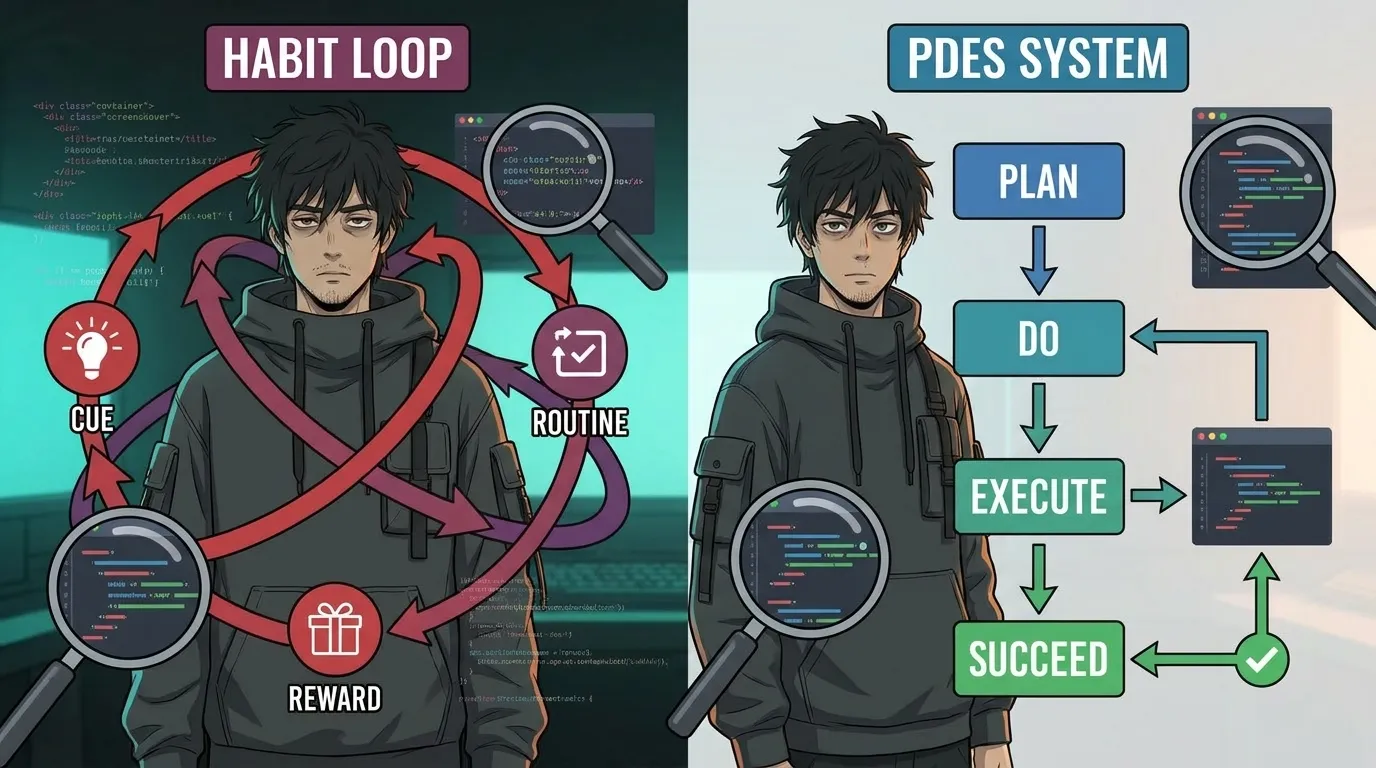
Ever feel like your life is running on legacy code—full of bugs, crashes, and features you never asked for?
Just like software, our habits, beliefs, and routines accumulate technical debt. If you don’t refactor, you accumulate inefficiency, burnout, and missed opportunities.
What Is Life Refactoring?
Life refactoring is the deliberate process of examining, restructuring, and optimizing the underlying “code” that runs your daily existence—your habits, mindset, routines, and systems. Borrowing from software engineering, it treats your life as a debuggable, version‑controlled system where every change can be tested, measured, and improved.
The goal isn’t perfection; it’s a reduced defect rate and higher system uptime—more energy, clarity, and results.

The 5‑Level Debug Protocol
PDES (Personal Development Engineering System) gives you a repeatable, five‑step loop that mirrors how engineers debug and refactor software:
- Perceive – Capture the raw data of your current state.
- Model – Translate that data into a clear state‑machine or flow diagram.
- Design – Create the target architecture and the protocols you’ll follow.
- Build – Generate SOPs, trackers, and the infrastructure to run the new code.
- Measure & Optimize – Apply Life Quant metrics, identify regressions, and iterate.
Level 1: Perceive – Mapping Your Current State
Start by dumping every relevant input into the input/ folder of your life: journals, time logs, expense records, health metrics, and feedback from peers. Then run a quick scan to surface patterns.
Actionable checklist:
- Track time in 30‑minute blocks for 3 days.
- Log mood and energy (1‑10) after each major activity.
- List recurring “complaints” or friction points you notice.
- Export the data to a simple CSV or markdown file.
Level 2: Model – Building Your Personal State Machine
Turn the raw perception into a visual model: identify states (e.g., Focused, Distracted, Recovering) and transitions (triggers that move you between them). This is your personal “finite state machine.”
Example state machine for work productivity:
- States: Deep Work, Shallow Work, Break, Burnout.
- Transitions:
- Deep → Shallow: Notification interruption.
- Shallow → Break: Completed a task block.
- Break → Deep: 5‑minute mindfulness reset.
- Deep → Burnout: >90 min without rest.
Level 3: Design – Creating Actionable Frameworks
With the model in hand, design the target architecture. Define the ideal state transitions, introduce guardrails, and write the “specifications” for new habits.
Design principles (borrowed from clean code):
- Single Responsibility: Each habit should serve one clear purpose.
- Loose Coupling: Minimize dependencies—don’t tie a new habit to an unstable routine.
- Explicit Interfaces: Define clear triggers and rewards (the API).
Formula for a habit trigger: Trigger = (Context Cue) × (Desired Response Strength). Increase either side to raise the probability of execution.
Level 4: Build – Implementing SOPs and Trackers
Now compile the design into tangible artifacts: Standard Operating Procedures (SOPs), checklists, and tracking dashboards that live in the output/ folder.
Build steps:
- Write an SOP for each new habit (trigger, routine, reward, timeout).
- Create a simple tracker (Google Sheet, Notion, or markdown) with columns: Date, Trigger Fired?, Routine Completed?, Outcome, Notes.
- Set up a weekly review ritual to pull metrics from the tracker.
Level 5: Measure & Optimize – Life Quant Metrics and Continuous Improvement
Apply the Life Quant scorecard—ten trading‑inspired metrics adapted to daily execution—to gauge the health of your refactored system.
Life Quant metrics (track weekly):
- Win Rate: % of planned habits executed successfully.
- Drawdown: longest streak of missed habits.
- Risk/Reward: effort invested vs. results gained.
- Expectancy: (Win Rate × Avg Gain) − (Loss Rate × Avg Cost).
- Sharpe Ratio: consistency of returns adjusted for volatility.
- Position Sizing: how much time you allocate to each habit.
- Profit Factor: total gains ÷ total losses.
- Max Favorable: best single‑day habit streak.
- Recovery Factor: bounce‑back speed after a drawdown.
- Opportunity Cost: value of alternatives forgone by current habit choices.
Run a retrospective every Sunday: calculate the metrics, identify the biggest “bug,” and feed it back into Level 1 for the next cycle.
Your Life Has Bugs. Here’s the Debugger.
If you’ve made it this far, you already see the parallels: your life is a system that can be perceived, modeled, designed, built, measured, and optimized—just like any piece of software. The life refactoring technique gives you a repeatable debugger to isolate the root cause of friction, patch it, and deploy an upgraded version of yourself.
Ready to run the debugger on your own existence?
Download the free 5‑level Debug Protocol, start perceiving your current state, and begin refactoring the code that runs your life.