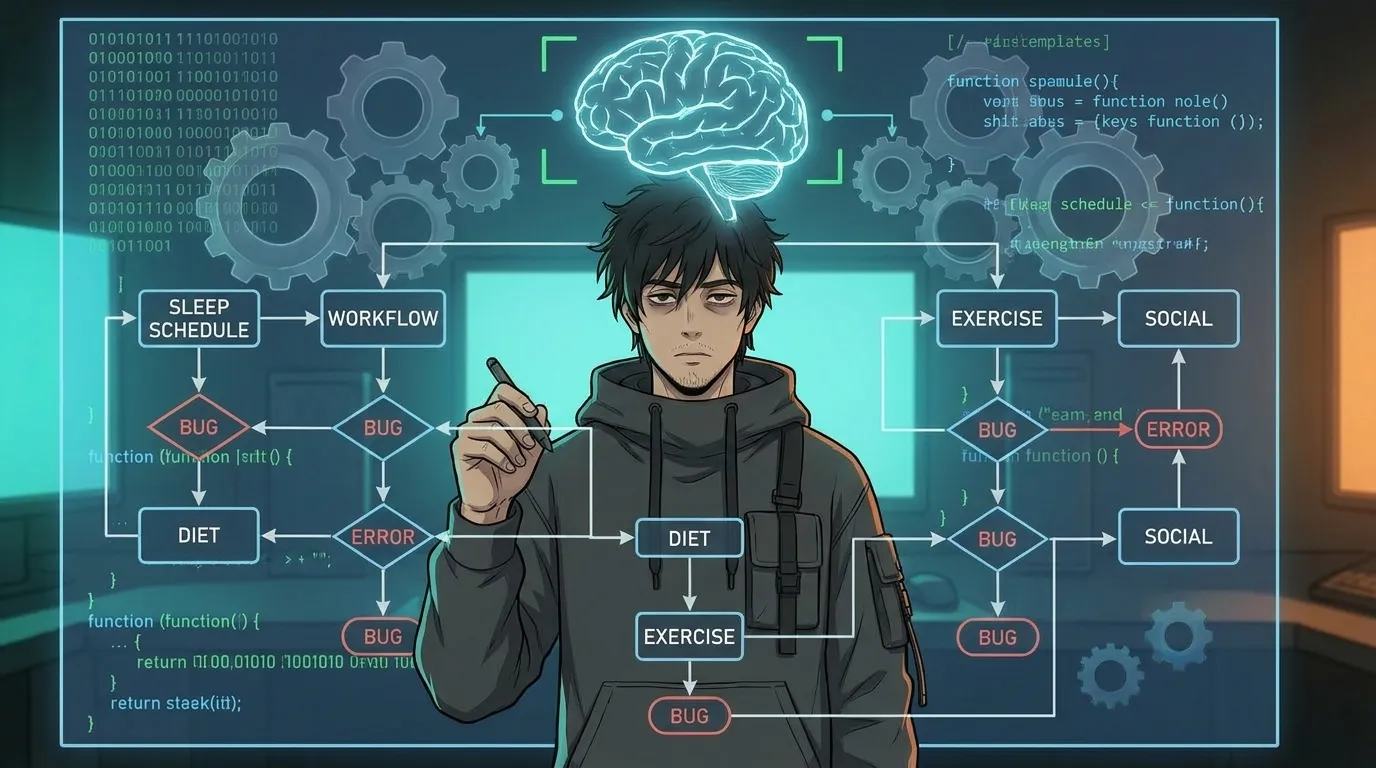
If the phrase “self‑help” makes you roll your eyes, you’re not alone. Most self‑help content feels like vague affirmations wrapped in glitter—nice to look at, but useless when you need a reliable, repeatable process. Analytical thinkers crave logic, measurable outcomes, and a system they can debug, not a pep talk.
This post introduces a personal development framework built on the same principles that run operating systems and software pipelines. It’s not a collection of tips; it’s a modular, debuggable engine you can install, run, measure, and optimize. Think of it as the Debug Protocol for your life.

Why Traditional Self‑Help Fails Analytical Minds
Typical self‑help relies on inspiration, anecdotal success stories, and one‑size‑fits‑all advice. For someone who thinks in terms of inputs, outputs, and error rates, that approach feels like trying to fix a bug by hoping the code will magically improve.
Analytical minds need three things:
- Clear definitions of the problem state.
- A deterministic process that transforms inputs into desired outputs.
- Metrics that tell you whether the process is working.
Treating Life as a Debuggable System
In software engineering, a system is defined by its state, its transitions, and the rules governing those transitions. Personal development can be modeled the same way:
- State: Your current habits, skills, knowledge, and environment.
- Transitions: Actions you take that move you from one state to another.
- Rules: The principles, habits, and feedback loops that determine which transitions are allowed.
When you treat your life like code, you can:
- Identify bugs (counterproductive habits) with a debugger mindset.
- Patch them by rewriting the underlying rules (habit loops).
- Run unit tests (small experiments) to verify the fix.
The 32‑Level PDES Framework: A Computer‑Science Ladder for Growth
PDES (Personal Development Engineering System) maps 32 foundational computer science concepts onto human development stages. Each level represents a new layer of abstraction, from the raw BIOS‑like instincts to high‑level quantum‑thinking strategies.
Level 0 – Null: No system, pure chaos.
Level 1 – BIOS: Basic survival routines (sleep, hunger, safety).
Level 5 – Loops: Repeating habits that either compound growth or entrench stagnation.
Level 12 – Object: Encapsulating skills into reusable modules (e.g., a “communication object”).
Level 24 – Kernel: Core decision‑making processes that schedule priorities.
Level 30 – Error: Mechanisms for detecting failure and triggering roll‑backs.
Level 31 – Admin: Meta‑control over the entire system, allowing self‑modification.
Progressing through the levels means you’re not just collecting tips; you’re upgrading your internal architecture. Each level adds a new capability—memory management, threading (parallel projects), virtualization (experimenting with identities), and eventually, garbage collection (letting go of what no longer serves you).
Applying Life Quant Metrics: The KPIs That Matter
Just as a software team tracks latency, error rate, and throughput, PDES tracks ten Life Quant metrics that give you a quantitative view of your personal system’s health.
- Win Rate: Percentage of actions that move you toward a goal.
- Drawdown: Maximum regression from a peak (e.g., a week of lost productivity).
- Risk/Reward: Effort invested versus outcome gained.
- Expectancy: Average net gain per action.
- Sharpe Ratio: Return per unit of stress or variability.
- Position Sizing: How much time/energy you allocate to each pursuit.
- Profit Factor: Total gains divided by total losses.
- Max Favorable: Best‑case trajectory if you keep optimizing.
- Recovery Factor: Speed of bounce‑back after a setback.
- Opportunity Cost: What you sacrifice by choosing one path over another.
By measuring these metrics weekly, you turn vague feelings of “progress” into concrete data. A low Sharpe Ratio, for example, tells you that your efforts are too volatile—you need smoother, more repeatable routines.
Building Your Personal Debug Protocol
The Debug Protocol is the concrete SOP (standard operating procedure) you generate from the PDES engine. It consists of six phases that mirror a software development lifecycle:
- 01 Perceive: Run a system scan—journal, time‑track, habit audit—to capture the current state.
- 02 Model: Translate observations into a state‑machine diagram (states, triggers, actions).
- 03 Design: Draft intervention patches (new habits, environmental changes).
- 04 Build: Create tangible artifacts—checklists, templates, tracking sheets.
- 05 Measure: Apply Life Quant metrics to the new protocol.
- 06 Optimize: Debug, refactor, and automate the habit loop until the metrics improve.
Each phase produces an artifact you store in the output/ folder of your personal repo. Over time, you accumulate a library of proven patches that you can recombine for new goals—just like reusable code modules.
From Theory to Execution: SOPs, Trackers, and Feedback Loops
Let’s walk through a mini‑example: improving deep‑work sessions.
Perceive: You log that you only achieve 45 minutes of uninterrupted work per day, with frequent context switches.
Model: You sketch a simple state machine: Idle → Distracted → Focused → Break → Idle. The transition from Idle to Distracted fires when a notification appears.
Design: You decide to add a “Do Not Disturb” rule and a physical cue (a red card on the desk) to block the Idle→Distracted transition.
Build: You create a tracker that logs start/end times of each Focused block and a checklist for pre‑session setup (phone off, card placed, timer set).
Measure: After one week, your Win Rate (focused blocks ≥ 45 min) rises from 0.3 to 0.65, and your Drawdown shrinks from 2 days to half a day.
Optimize: You notice that after 90 minutes, mental fatigue spikes. You experiment with a 5‑minute micro‑break rule (Stretch, hydrate) and see the Sharpe Ratio improve.
This loop—Perceive → Model → Design → Build → Measure → Optimize—is repeatable for any goal: fitness, learning, relationships, or finances.
Why This Approach Respects Your Analytical Nature
Unlike vague affirmations, PDES gives you:
- Transparency: Every rule is explicit; you can read the code.
- Falsifiability: If a metric doesn’t move, the hypothesis is wrong and you iterate.
- Scalability: Start with a single habit, then compose higher‑level systems (career projects, lifelong learning tracks).
In short, you get a system that thinks like you do: logical, measurable, and improvable.
Getting Started: Your First Debug Protocol
Ready to install the engine? Follow these three steps:
- Clone the Repo: Visit the link below and download the starter kit (includes the perceive template, a basic state‑model canvas, and a Life Quant tracker).
- Run Perceive: Spend 30 minutes filling out the perceive sheet—capture your current habits, energy levels, and pain points.
- Build Your First Patch: Choose ONE metric you want to improve (e.g., Win Rate for deep work). Use the design canvas to draft a tiny habit patch, then build the tracker and start measuring.
From there, let the PDES loop take over. Each iteration makes your personal system more reliable, more efficient, and more aligned with your analytical mindset.
Final Thoughts
Self‑help doesn’t have to be fluffy. When you treat your life as a debuggable system, you replace wishful thinking with engineering rigor. The result is a personal operating system that runs smoother, fails less often, and lets you allocate your precious cognitive bandwidth to what truly matters.
If you’re tired of generic advice and hungry for a framework that speaks your language, it’s time to debug your life.
Click the button above to download the starter kit and begin engineering the version of yourself you actually want to run.