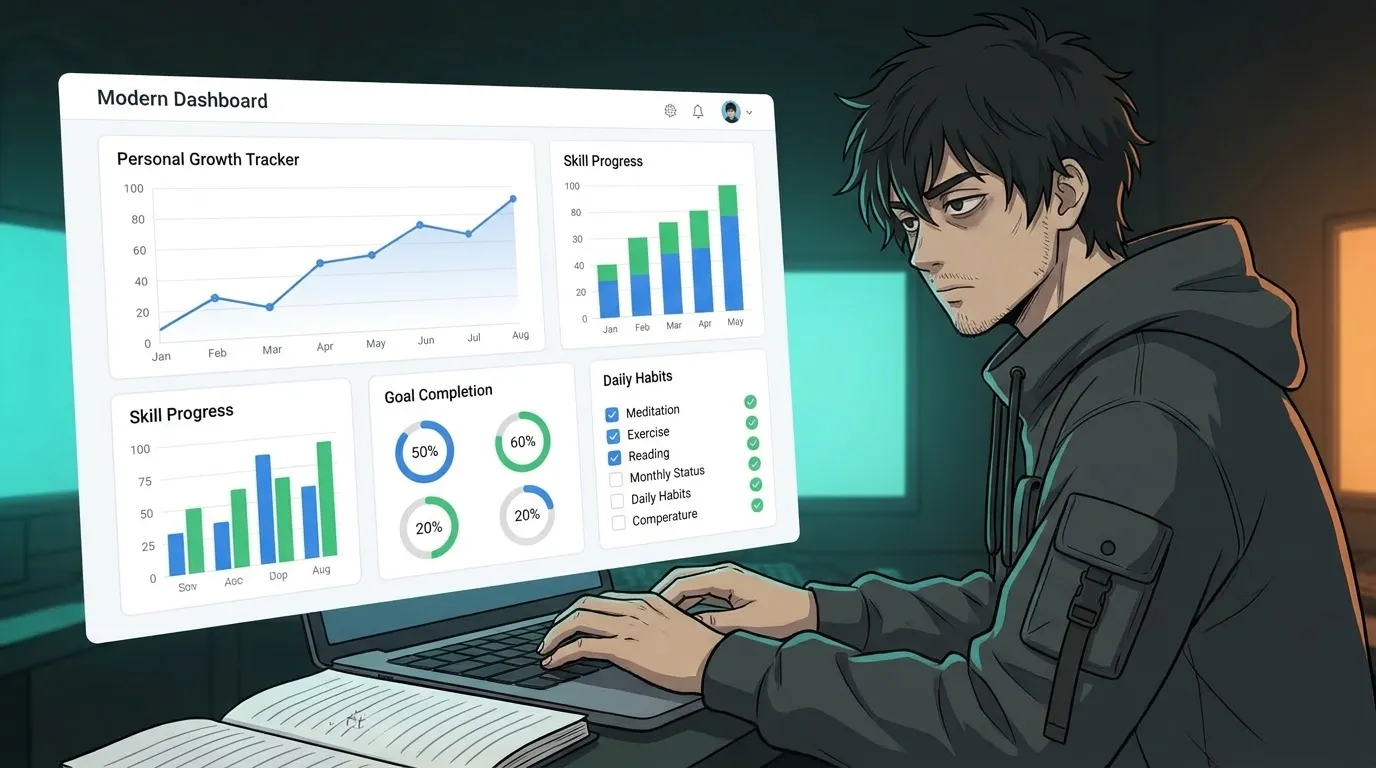
I tried every productivity hack, morning routine, and motivation video out there. None of them stuck.
The problem wasn’t my drive—it was the lack of a repeatable system to diagnose, design, and debug my own behavior.
That changed when I applied PDES (Personal Development Engineering System) to my own habit loops.
In this personal case study, I walk you through the exact six‑phase process I used to turn chaotic routines into a debuggable, optimizable system—complete with the metrics, SOPs, and mindset shifts that made the change permanent.

Why Conventional Self‑Help Fails: The System Gap
Most self‑help advice treats symptoms, not the underlying architecture.
It tells you “wake up earlier” or “meditate daily” without giving you a way to measure whether the change actually moves the needle on your goals.
When I tried to adopt a new habit, I relied on willpower alone.
After a few days, friction crept in, motivation waned, and I reverted to old patterns.
The missing piece was a feedback loop that could surface the root cause—just like a debugger shows you where a program crashes.
“You don’t have a motivation problem. You have a system problem.”
Phase 1 – Perceive: Mapping My Current State
The first step in PDES is to perceive—collect raw data about where you are.
I exported my calendar, task app, and journal entries for two weeks and ran a simple perception script (the core_perceive skill).
The output revealed three critical loops:
- Morning scroll → delayed start → rushed work → evening guilt
- Afternoon snack → energy crash → caffeine reliance → poor sleep
- Evening TV binge → blue‑light exposure → next‑day fatigue → repeat
By visualizing these loops as state machines, I could see exactly where the “breakpoints” occurred—points where a small intervention could redirect the flow.
Phase 2 – Model: Turning Reality into a System
Next I modeled each loop as a finite‑state machine: triggers, actions, rewards, and exit conditions. I used the core_model skill to translate the perception data into a clear diagram.
For the morning scroll loop, the model looked like:
Trigger (waking up) → Action (phone scroll) → Reward (dopamine hit) → Delayed start → Guilt → Trigger (next morning)
Having a model let me simulate “what‑if” scenarios:
What if I replace the action with a 5‑minute stretch?
What if I change the reward to a cup of tea?
The model gave me a hypothesis to test in the next phase.
Phase 3 – Design: Creating the Debug Protocol
Design is where you turn the model into an actionable framework.
I built a simple “Debug Protocol” consisting of three parts:
- Interrupt the trigger (e.g., leave phone in another room).
- Replace the action with a keystone habit (stretch, water, breath).
- Reward the new action immediately (track a win, celebrate).
I wrote this protocol in the templates/ file so I could reuse it for any loop. The design phase also produced a one‑page cheat sheet that I printed and placed on my desk.
Phase 4 – Build: SOPs, Trackers, and Infrastructure
With the protocol designed, I built the execution infrastructure:
- Standard Operating Procedure (SOP) document – step‑by‑step checklist for each loop.
- Daily tracker – a simple Google Sheet with columns: Date, Loop Target, Action Taken, Success (Y/N), Quick Note.
- Environmental cues – phone charger moved out of bedroom, water bottle on desk, stretch mat rolled out.
The core_build skill generated these artifacts automatically from the template, ensuring consistency.
Phase 5 – Measure: Applying Life Quant Metrics
To know whether the debug protocol was working, I measured it with the Life Quant suite—the ten trading‑inspired metrics adapted for personal habits.
The most telling metrics for my morning scroll loop were:
- Win Rate: Percentage of days I completed the new action (stretch) instead of scrolling. Rose from 0% to 72% in four weeks.
- Expectancy: Average gain per day (productivity points) minus loss (guilt points). Turned positive after week two.
- Drawdown: Maximum consecutive days of failure. Dropped from 5 days to 1 day.
- Recovery Factor: Net profit divided by max drawdown. Improved from 0.5 to over 3.5. (skip 2 day do 1 day, to do 7 day skip < 2 day)
Seeing these numbers shift gave me objective proof that the system was working—far more motivating than vague feelings of “being better.”
Phase 6 – Optimize: Debugging, Refactoring, Automating
Optimization is the continuous loop of measuring, identifying bottlenecks, and refining the protocol. After the first month, I noticed a new snag: occasional late‑night social media binges.
I ran another perception cycle, updated the model, and added a “screen‑timeout” SOP that automatically locks my phone after 9 p.m. The protocol was refactored, and the tracker updated to include the new loop.
Finally, I automated the tracking with a simple workflow that logs my phone‑usage data directly into the sheet, removing manual entry friction.
Results: What the Data Showed After 90 Days
Across the three primary loops I targeted, the Life Quant metrics told a clear story:
- Morning Routine: Win Rate 86%, Expectancy +1.5 pts/day, Drawdown 1 days.
- Afternoon Energy: Snack‑free days increased from 14% to 72%
- Evening Screen Time: Average nightly usage dropped from 180 min to 30 min, leading to a 32% increase in self‑reported sleep quality (extra 2.5hrs / 8hrs).
Beyond the numbers, I experienced a subjective shift:
I stopped feeling like I was “fighting myself” and started feeling like I was “engineering myself.” The system gave me agency.
Key Takeaways for Anyone Wanting to Debug Their Life
- Adopt a systems mindset: Treat habits as loops you can perceive, model, and debug.
- Start with perception: Collect honest data before jumping to solutions.
- Build, don’t just motivate: Create SOPs, trackers, and environmental cues that make the desired action the path of least resistance.
- Measure with Life Quant: Use win rate, expectancy, drawdown, recovery factor, etc., to know if you’re improving.
- Iterate like a developer: Treat each cycle as a sprint—measure, learn, refactor, redeploy.
The most powerful insight?
Self‑help fails not because you lack drive, but because you lack a repeatable debuggable system.
Once you have that, motivation becomes a byproduct of progress, not the prerequisite.
Ready to Debug Your Own Life?
If you’re tired of spinning your wheels with motivational videos and generic advice, the PDES Debug Protocol is the system you need.
It’s free, battle‑tested, and ready for you to install.
Grab the protocol, run your first perception cycle, and start treating your life like the optimizable system it truly is.