Feel stuck in a loop of recurring mistakes? You set goals, you try new habits, yet the same errors keep surfacing—like a program that crashes every time you run it. What if you could treat your life exactly like a software system: locate the bug, isolate the root cause, apply a patch, and verify the fix?
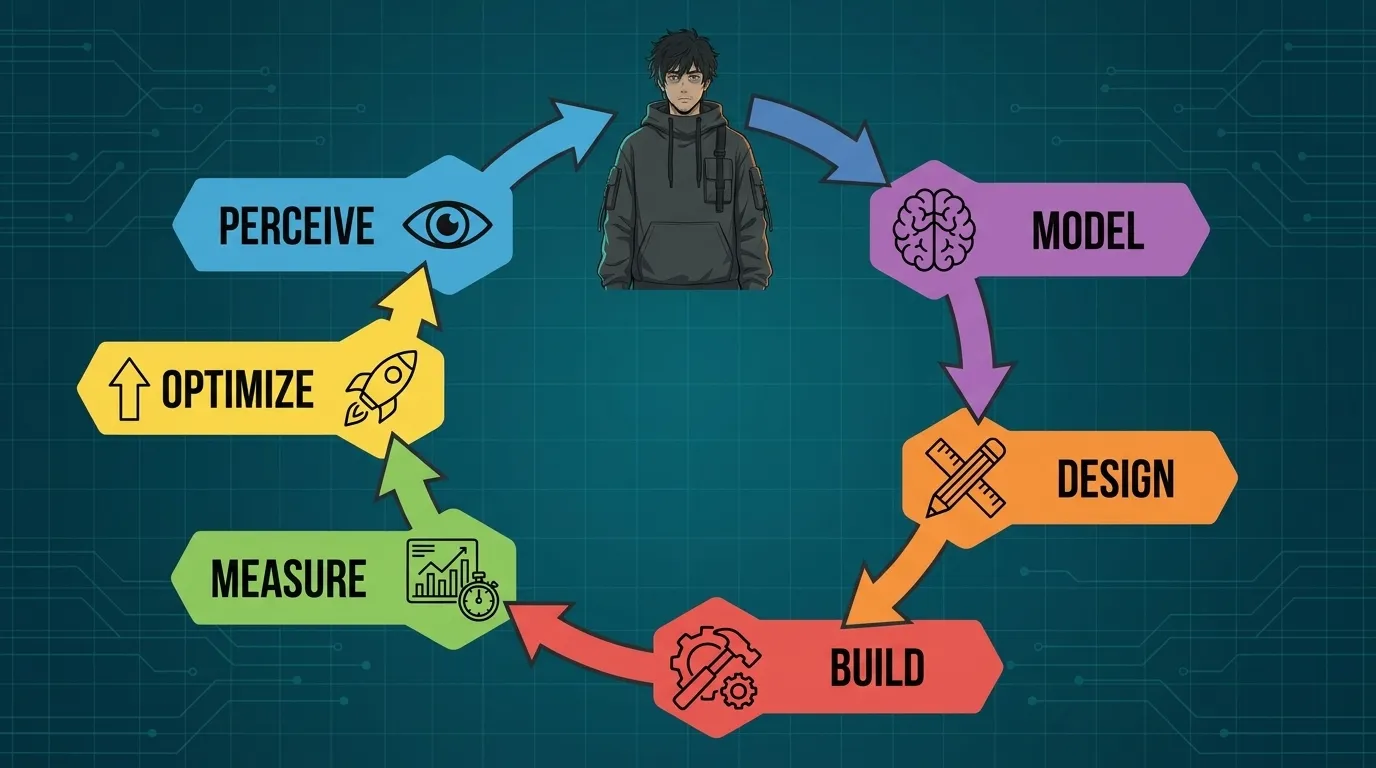
Computer scientists don’t guess why code fails; they run diagnostics, examine state, design fixes, test, and iterate. By borrowing that exact debugging workflow, you gain a repeatable, measurable way to upgrade any area of life—health, career, relationships, or mindset. Below is the 5‑Level Debug Protocol that turns personal growth into a systematic, optimizable process.

Phase 0: Perceive – Run a Diagnostic Scan
Before you can fix anything, you must know what’s broken. This phase gathers raw data about your current state—no judgment, just observation.
- Time audit: Log how you spend each hour for 3 days.
- Energy map: Rate your energy (1‑10) after major activities.
- Outcome log: Note successes and failures in a simple spreadsheet.
“You cannot improve what you do not measure.” – Adapted from engineering principle
Output: A clear perception report—your system’s baseline metrics and symptom list.
Phase 1: Model – Map Your System State
Turn the raw perception into a structured model. Define the components (habits, environments, beliefs) and how they interact—just like drawing a system architecture diagram.
- Identify modules: Break life into modules (e.g., Sleep, Nutrition, Work, Relationships).
- Define state variables: For each module, pick 2‑3 measurable variables (e.g., Sleep: hours, quality score).
- Sketch interactions: Draw arrows showing how one module affects another (e.g., Poor Sleep → Lower Work Focus).
System State = {Module₁: [vars], Module₂: [vars], …}
Output: A readable state‑machine or flowchart that shows where leaks or bottlenecks likely exist.
Phase 2: Design – Create Patch Plans
With a model in hand, hypothesize the root cause(s) and design specific, testable interventions—your “patches.”
- Root‑cause hypothesis: Use the “5 Whys” on each symptom to drill down.
- Patch definition: State the change as an IF‑THEN rule (e.g., IF bedtime > 11 pm THEN set alarm for 10:30 pm wind‑down).
- Success criteria: Define what a successful patch looks like (e.g., Sleep quality ≥ 8/10 for 5 consecutive nights).
“A good patch is small, reversible, and measurable.”
Output: A list of numbered patches, each tied to a module and a clear metric.
Phase 3: Build & Measure – Deploy Fixes and Track Results
Now implement the patches, but treat each as an experiment. Build the minimal viable change, then measure its impact using Life Quant metrics.
- Build the SOP: Write a one‑page Standard Operating Procedure for the patch.
- Run a 2‑week sprint: Execute the patch only; keep everything else constant.
- Measure: Apply at least three Life Quant metrics—Win Rate, Expectancy, and Recovery Factor—to the module.
Expectancy = (Win Rate × Avg Gain) − ((1‑Win Rate) × Avg Loss)
Output: A measurement dashboard showing whether the patch moved the metric in the desired direction.
Phase 4: Optimize – Automate and Prevent Regressions
If a patch works, lock it in. If it fails, iterate. Use optimization techniques to make the fix robust and low‑maintenance.
- Refactor: Simplify the SOP—remove steps that didn’t contribute to the win.
- Automate triggers: Use calendar alerts, habit‑stacking, or environment design to fire the behavior automatically.
- Regression test: Weekly, run a quick “smoke test” to ensure the patch still holds; if not, roll back to previous known‑good state.
“Optimization is not about doing more; it’s about eliminating waste.”
Output: A stable, automated habit that runs with minimal conscious effort—your life’s new baseline.
Synthesis: How the Five Levels Form a Debug Loop
These levels are not a one‑off checklist; they create a continuous improvement cycle:
- Perceive → collect data.
- Model → turn data into a map.
- Design → hypothesize patches.
- Build & Measure → run experiments and quantify.
- Optimize → lock in wins or loop back to Perceive with new data.
Each pass reduces the “bug count” in your life, increasing overall system reliability and performance—just like a well‑maintained codebase.
Your First Debug Session: A Quick Start Guide
- Pick ONE module that feels most buggy (e.g., Morning Routine).
- Spend 15 minutes running the Perceive step: log timing, energy, outcomes for today.
- Draft a simple model: list the sub‑steps and note where you feel friction.
- Design ONE patch: a tiny tweak (e.g., place water glass by bed to hydrate immediately).
- Build the SOP, run it for 3 days, measure Win Rate (% days you completed the patch).
- If Win Rate ≥ 80 %, automate; otherwise, redesign and repeat.
Take Action: Deploy Your Personal Debugger
You now have a repeatable, computer‑science‑grade system to locate, isolate, and patch any life bug. The next step is to get the full Debug Protocol—a 5‑level framework complete with templates, tracking sheets, and optimization checklists—so you can start debugging today.
Click the link to download your free Debug Protocol and begin treating life like the optimizable system it truly is.