Most personal development advice feels like a patchwork of motivational quotes and vague habits—useful for inspiration, but useless when you need a repeatable, measurable system.
As an engineer, you thrive on logic, inputs, outputs, and debugging. Yet you’re expected to grow using advice that ignores the very mindset that makes you successful at work.
What if you could treat your growth like a codebase: perceive the current state, model it as a state machine, design protocols, build infrastructure, measure performance, and continuously optimize?
That’s exactly what the Personal Development Engineering System (PDES) does—applying computer science fundamentals to human performance.
1. The Engineer’s Mindset: Why Traditional PD Fails
Traditional self‑help treats growth as a series of isolated tips—“wake up early,” “read more,” “meditate.” For engineers, this approach feels like trying to fix a distributed system by randomly toggling switches.
- Lack of traceability: No clear input‑process‑output flow.
- No version control: You can’t roll back a bad habit or A/B test a new routine.
- Ignoring leverage: Generic advice misses the high‑impact, low‑effort routines that compound like algorithmic optimizations.
“If you can’t measure it, you can’t improve it.” – Lord Kelvin (a principle every engineer lives by).
2. Applying CS Concepts to Life: The 32‑Level Ladder
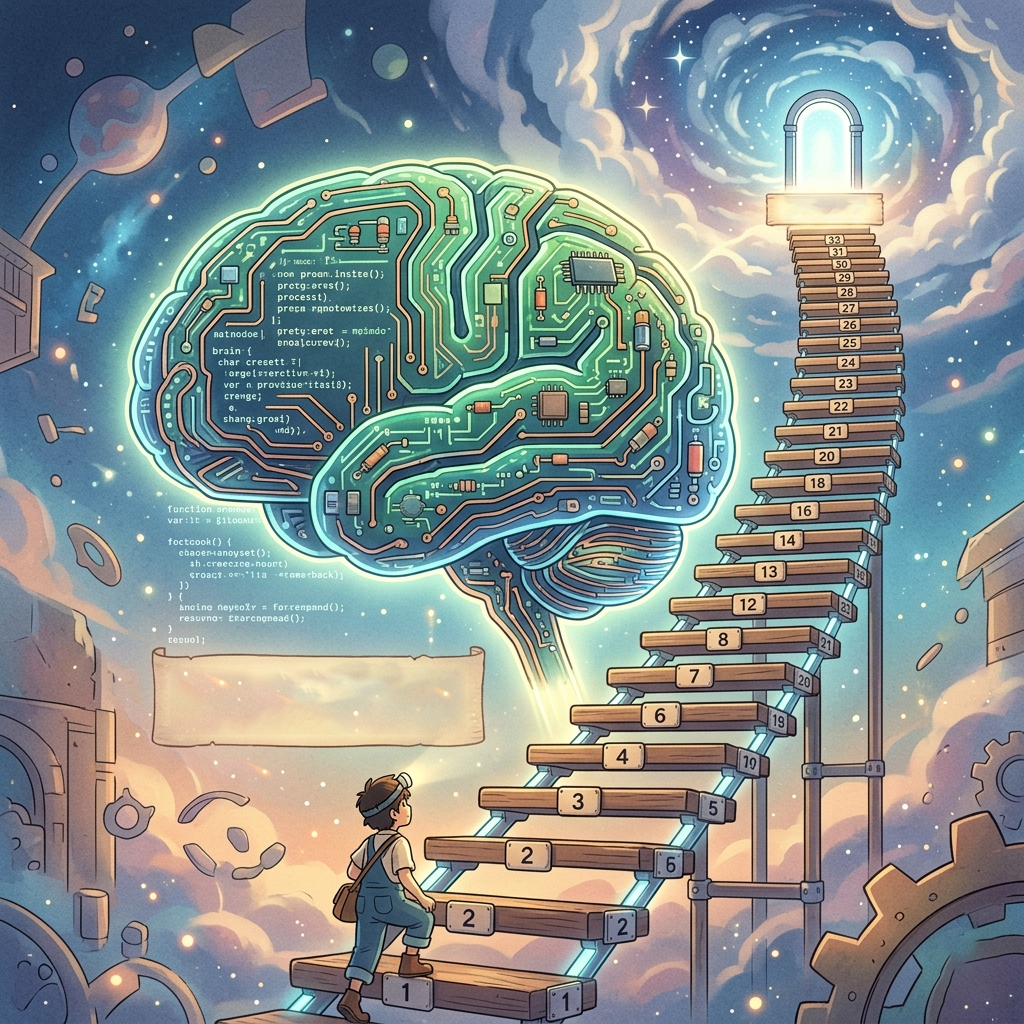
PDES maps 32 foundational computer science concepts—from BIOS to Quantum Computing—to human development stages. Each level represents a new abstraction layer you can install in your psyche, just like stacking software layers.
- BIOS (G0): Core survival routines—sleep, nutrition, basic hygiene.
- Variables (G2): Naming and tracking your key metrics (energy, focus, mood).
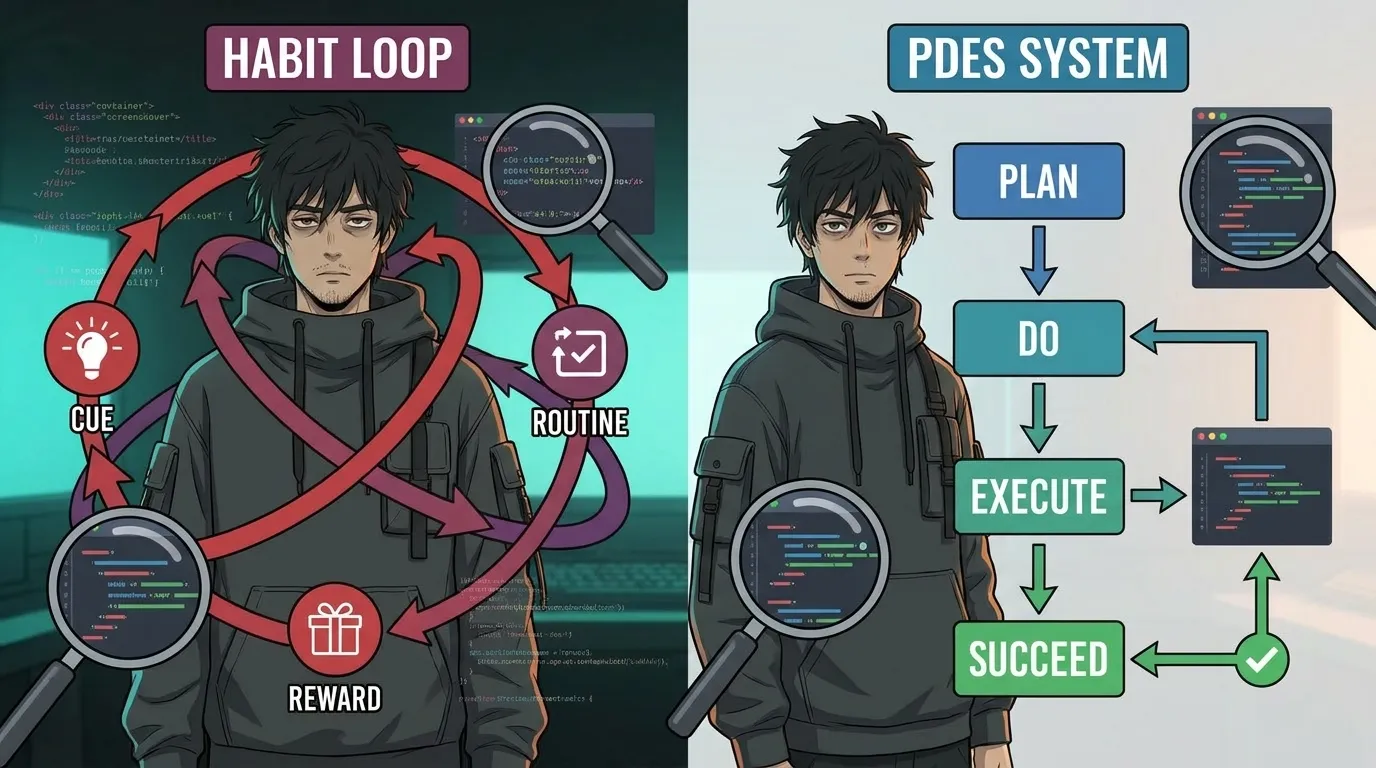
- Loops (G3): Building habit loops—cue, routine, reward—debugged for efficiency.
- Object‑Oriented (G7): Encapsulating traits into reusable “classes” like Discipline, Curiosity, Resilience.
- Virtualization (G10): Running multiple identities (engineer, leader, learner) without conflict.
- Quantum (G22): Embracing probabilistic thinking and superposition of goals.
3. The PDES Pipeline: Input → Process → Output for Growth
Just like a software system, personal growth follows a strict pipeline. Skip a stage and you get bugs—burnout, inconsistency, plateau.
- Input (Perceive): Capture raw data—time logs, mood scores, skill assessments—using the
/perceivecommand. - Process (Model → Design → Build): Translate data into a state machine, design protocols, and generate SOPs (Standard Operating Procedures) via
/model,/design,/build. - Output (Measure → Optimize): Apply Life Quant metrics (Win Rate, Sharpe Ratio, Expectancy, etc.) with
/measureand refine via/optimize.
“Your life is a debuggable system. Treat every setback as a stack trace, not a defeat.”
4. Measuring & Optimizing with Life Quant Metrics
- Win Rate: % of days you hit your core intention.
- Drawdown: Maximum consecutive days below baseline—helps you anticipate burnout.
- Risk/Reward: Effort invested vs. outcome gained for each habit.
- Expectancy: Average daily growth per unit of effort.
- Sharpe Ratio: Return (growth) per unit of variability (stress). Higher = smoother progress.
- Position Sizing: How much time you allocate to each skill area based on expected ROI.
Putting It All Together: Your Personal Growth OS
When you run the full PDES cycle—perceive, model, design, build, measure, optimize—you create a feedback loop that compounds. Each iteration refines your internal “kernel,” making you more efficient, resilient, and capable of tackling higher‑level challenges (think moving from debugging scripts to architecting distributed systems).
- Clarity: You always know the next actionable step (no more “what should I do?”).
- Accountability: Metrics provide objective feedback, not fleeting motivation.
- Scalability: Start with BIOS‑level habits, then stack up to Quantum‑level strategic thinking.
Ready to Debug Your Life?
Stop collecting tips. Start engineering your growth with a system that thinks like you do—built on 32 levels of computer science logic, powered by Life Quant metrics, and designed for engineers who demand precision.
Click the button to receive the full PDES framework, level‑by‑level guides, and the Life Quant tracker—everything you need to compile your personal growth OS today.