
Feel like you’re working hard but not seeing the progress you want?
Most people navigate life without a dashboard, guessing whether they’re improving or just spinning wheels. The missing piece isn’t effort—it’s measurement.
Just as a startup tracks CAC, LTV, and churn to know if it’s winning, you need Life KPIs to know if your habits, health, and relationships are moving you forward.
By applying system thinking, you turn vague aspirations into quantifiable signals you can act on.
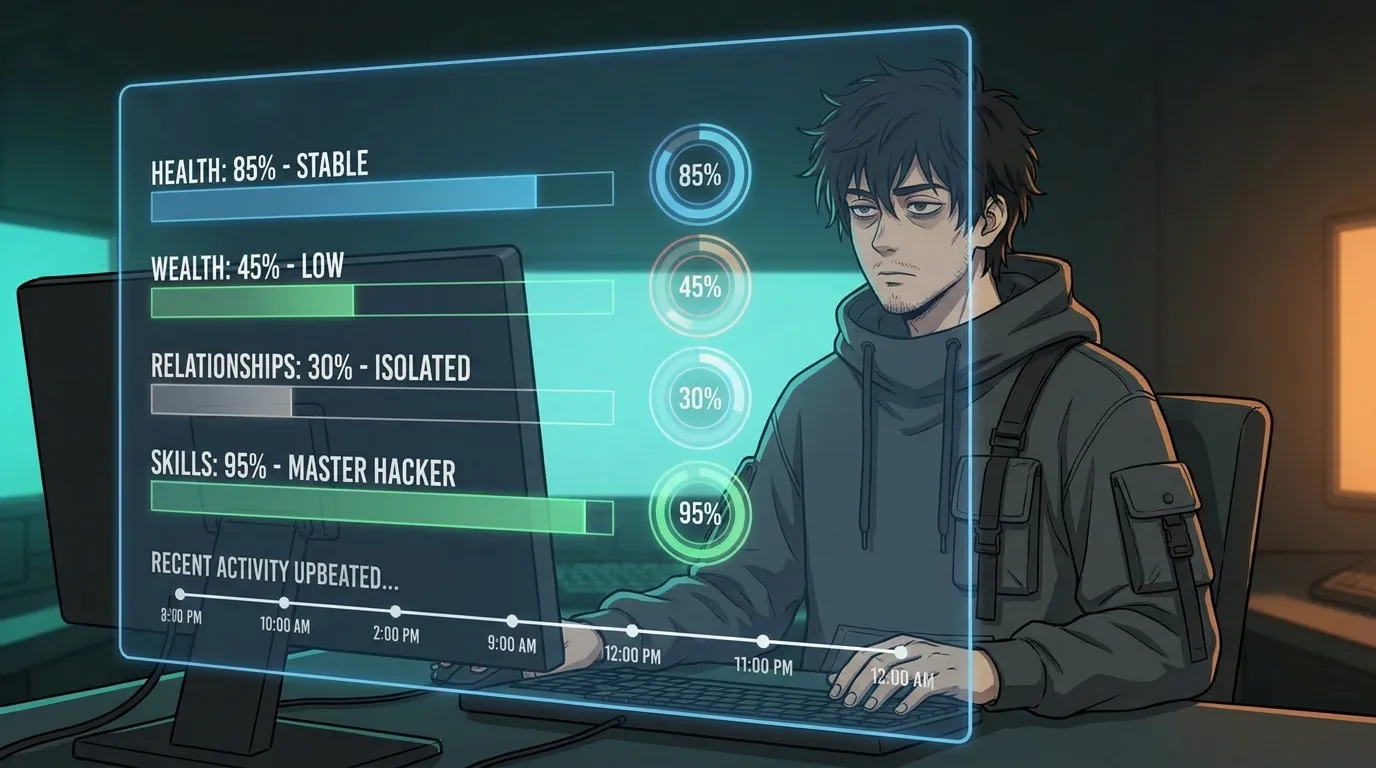
Life KPIs: The Vital Signs of Your Personal Growth
Life KPIs are the specific, measurable indicators that reflect the health of your core systems: body, mind, career, and connections.
Unlike vague goals like “be healthier,” a Life KPI gives you a number you can track weekly.
Life KPI = (Desired Outcome) × (Frequency of Measurement) ÷ (Variance Tolerance)
Pick metrics that are:
- Relevant to a core area of life (e.g., resting heart rate for health).
- Responsive to your actions (if you exercise, the number changes).
- Simple to collect with minimal friction (a quick journal entry or wearable sync).
System Thinking: Building a Feedback Loop for Your Life
System thinking means viewing your life as a set of interconnected stocks (resources) and flows (actions).
When you measure a KPI, you create a feedback loop that tells you whether a flow is filling or draining a stock.
The basic loop looks like this:
Action → Metric Change → Insight → Refined Action
To make the loop work:
- Define the stock you want to grow (e.g., energy).
- Identify the flows that affect it (sleep, nutrition, stress).
- Choose a KPI that reflects the net flow (e.g., morning energy score 1‑10).
- Review the KPI weekly and adjust the flows accordingly.
Personal KPIs: Choose Metrics That Actually Move the Needle
Not all metrics are created equal. The best Personal KPIs are leading indicators—they change before the result shows up, giving you time to course‑correct.
Here are five high‑impact Life KPIs to start tracking today:
- Sleep Efficiency % (time asleep ÷ time in bed). Directly impacts recovery and cognitive performance.
- Deep Work Hours (focused, distraction‑free time on high‑value tasks). Predicts project completion speed.
- Relationship Investment Score (weekly minutes spent in meaningful conversation with key people). Leading indicator of social support.
- Skill Acquisition Rate (hours per week devoted to deliberate practice of a target skill). Forecasts mastery timeline.
- Net Energy Balance (subjective energy rating 1‑10 minus estimated stress load). Shows whether you’re accumulating or burning reserves.
Tracking Life KPIs: Tools, Routines, and Review Cycles
Consistency beats complexity. Choose a lightweight system you’ll actually use every day.
Tool stack options:
- Analog: A simple notebook with a weekly spread; write the KPI value and a one‑sentence note.
- Digital: A habit‑tracking app (Notion, Airtable, or a dedicated tracker) with automated reminders.
- Hybrid: Wearable data auto‑flows into a spreadsheet; you add qualitative context manually.
Review cadence:
- Daily: Log the raw data (takes < 2 minutes).
- Weekly: Calculate the weekly average, note trends, and decide one tweak for the coming week.
- Monthly: Look at the 4‑week chart, celebrate wins, and reset targets if needed.
From Data to Action: Optimizing Your Life KPIs Over Time
Data without action is just noise. The optimization step turns insights into precise experiments.
Follow the OODA loop adapted for personal KPIs:
- Observe: Check your KPI trend—is it up, flat, or down?
- Orient: Ask what changed in your inputs last week (new habit, travel, illness).
- Decide: Pick one input to adjust up or down by a small, testable amount (e.g., +15 minutes of deep work).
- Act: Implement the change and log the result.
Repeat. Over months, you’ll compound small tweaks into exponential growth—just like a startup refining its funnel.
Bringing It All Together: Your Life KPI System
When you treat life as a measurable system, you stop guessing and start engineering. Life KPIs give you the feedback, system thinking gives you the framework, and consistent tracking gives you the leverage to turn intention into inevitable progress.
Start small: pick one KPI from the list above, log it for seven days, and review. Notice how the simple act of measurement shifts your behavior.
Ready to debug your life and install a real‑time performance dashboard?